Crane and Rigging Training in VR: Building Lift Competence Without Stopping the Crane

"Every hour a crane spends on training is an hour it is not lifting. That single fact explains most of what is wrong with crane training.
Lifting operations concentrate risk in a way few other industrial activities do. A load in the air over a working area, dependent on a rigging arrangement assembled by one person, a lift plan approved by another, and coordination between an operator who often cannot see the load and a signaller who cannot see the hook.
The competency requirements are correspondingly high. Operators, riggers, slingers, signallers and the appointed person all need to be competent, and they need to be competent together, because most lifting incidents are failures of coordination rather than individual skill.
But the training asset is the production asset. Practising a blind lift on the shop floor crane means the shop floor crane is not moving material. Practising a tandem lift means two cranes are idle. So training gets compressed, deferred, and reduced to the minimum that satisfies certification.
Key takeaways
- Crane training competes directly with production for the same equipment, which limits how much practice anyone gets.
- Most lifting incidents involve coordination between roles, not individual operator error.
- VR trains operator, rigger and signaller together in a shared environment without touching the real crane.
- Rigging arrangements can be built incorrectly and taken to failure, which is the fastest way to teach load calculation.
- Multi-user scenarios expose communication breakdowns that single-role training never surfaces.
The coordination failure
Read a set of lifting incident reports and a pattern appears quickly. The rigging was adequate. The crane was within capacity. The operator was certified. And the load still swung into a structure, or landed on someone, or dropped.
What went wrong sits in the space between roles. The signaller gave a stop signal that the operator did not see. The rigger changed the sling arrangement after the lift plan was approved and did not tell anyone. The operator assumed the area was clear because it had been clear ten minutes earlier. Nobody stopped the lift when conditions changed, because stopping a lift is socially expensive and each person assumed someone else had a better view.
Single-role training cannot address any of this. A rigger trained alone learns rigging. What they need to learn is rigging while communicating with a signaller and an operator who each hold part of the picture.
Shared-environment training
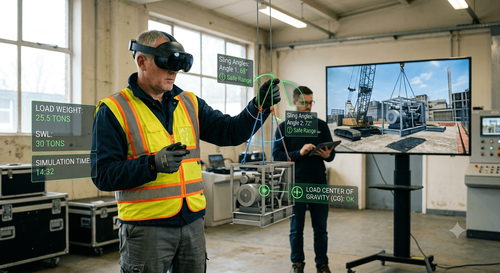
Multi-user VR puts the whole lift team into one scenario simultaneously, each in their own role and their own viewpoint.
The operator sits in the cab with the actual sightlines of that crane, which for an overhead travelling crane means looking down through structure, and for a mobile crane means a boom obscuring the load at certain angles. The rigger works at the load, assembling the arrangement. The signaller stands where they would stand, with the visibility they would actually have. They communicate by voice or by standard hand signals, and the system records what each person could see at each moment.
Then conditions change. Wind picks up. A pedestrian enters the exclusion zone. The load shifts. An outrigger settles. A radio fails and the team has to fall back to hand signals with a partially obstructed view.
The debrief is where the learning concentrates. Replaying the lift from each participant's viewpoint shows the team exactly where their shared understanding diverged. That conversation is very difficult to have from memory after a real lift.
Rigging that can be got wrong
Rigging competence is fundamentally about load calculation and geometry, and both are much easier to understand when you can see the consequence.
In VR, learners select slings, shackles and lifting accessories from the actual inventory available on their site, assemble an arrangement, and lift. If the sling angle is too shallow, the tension multiplies and the sling fails. If the centre of gravity was misjudged, the load tilts and slides. If the shackle was side-loaded, it deforms. If a damaged sling was selected during inspection, it parts under load.
None of this is possible physically. You cannot ask a trainee to rig a load incorrectly and lift it to see what happens. So sling angle factors get taught as a table on a slide, and the table gets memorised for the exam and forgotten within a month.
Learners also practise the parts of rigging that are procedurally simple but frequently skipped: pre-use inspection of every accessory, verifying the load weight rather than estimating it, checking the certification, and confirming the lifting points are actually lifting points.
Scenarios by crane type
The environment is built around the crane and the work the organisation actually does.
Overhead travelling cranes in manufacturing bays, where the constraints are limited hook height, obstructions, load swing in confined aisles, and people working beneath the travel path.
Mobile and crawler cranes on construction and project sites, where ground bearing pressure, outrigger setup, load charts, radius changes and boom configuration dominate. Setting up on unverified ground and watching the machine settle is one of the more instructive experiences available in simulation.
Tower cranes, with blind lifts, multiple crane interaction, and the operator's total dependence on the signaller.
Port and yard handling, including container spreader operations, twin-lift and coordination with vehicle traffic.
Specialist lifts, including tandem lifts, lifting through openings, and lifts over live plant, where the lift plan matters more than the machine.
The appointed person and lift planning
Lift planning is usually taught through documentation. A trainee reads example plans and produces one for assessment.
Simulation adds a step that documentation cannot. The trainee produces a lift plan, then executes it in the environment and watches it fail for reasons the paperwork did not capture. The radius was calculated for the pick point but not the set point. The tail swing hits a structure. The ground under the outrigger is soft. The exclusion zone conflicts with a walkway that people actually use.
Producing a plan, seeing it break, and revising it teaches lift planning faster than any number of worked examples.
What it costs the operation
The operational argument is direct. A crane withdrawn from service for training has a measurable cost per hour, in production output or project schedule. In a plant where the overhead crane is a bottleneck resource, that cost is high.
VR training moves most of the learning off the asset. The crane is still needed for practical assessment and for final competency verification, but the hours spent on familiarisation, sequence learning, hazard recognition and coordination move into a training room.
For organisations running multiple sites, there is a second argument. Lift planning and rigging standards drift between sites when training is delivered locally by different people. A shared simulation environment enforces one standard.
Frequently asked questions
Does VR replace crane operator certification?
No. Certification requirements and practical assessment on the real machine remain. VR reduces the machine hours required and covers scenarios that cannot be run physically.
Can multiple people train in the same scenario at once?
Yes. Multi-user scenarios with operator, rigger and signaller in separate headsets are one of the strongest applications, because they train the coordination that causes most incidents.
How accurate are the load physics?
Well-built modules model load mass, centre of gravity, sling tension, swing dynamics and stability with enough fidelity that incorrect rigging fails realistically.
Can we use our own cranes and lifting inventory?
Yes. Modules are built from your equipment specifications, load charts, site layouts and accessory inventory so that learners work with what they will actually use.
If you want to see one of your own routine lifts rebuilt as a multi-role simulation, EDIIIE can develop it and run your lift team through it."