Digital Twins and VR: Training Operators Before the Plant Exists

"The most expensive weeks of a new plant's life are the ones where the equipment works and the people do not know it yet.
Every capital project ends the same way. Construction completes, commissioning begins, and the operating team meets the plant for the first time. They have read the manuals. They have attended vendor training. They may have visited a similar facility. But they have never operated this plant, because until now it did not exist.
What follows is a ramp-up period measured in months, during which output is below design, errors are frequent, and the most experienced engineers spend their time answering questions instead of resolving commissioning issues.
This period is treated as unavoidable. It is not, or at least not entirely. The plant existed as a model long before it existed in steel, and that model can be used to train the people who will run it.
Key takeaways
- The engineering model built for design can be reused as a training environment years before commissioning.
- Operators can learn layout, sequences and emergency response before the plant is physically accessible.
- Design reviews in VR catch operability and maintainability problems while changes are still cheap.
- The same environment continues to serve training, maintenance planning and change management after handover.
- The value depends on planning the reuse during the project, not after it.
What a digital twin means here
The term is used loosely, so it is worth being precise about the three levels, because they carry very different costs.
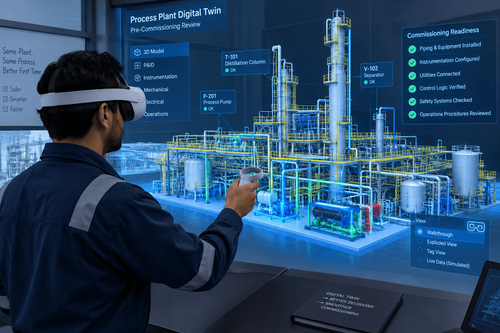
A visual twin is a geometrically accurate 3D model of the facility, built from the engineering CAD, plant design and laser scan data. It supports spatial familiarisation, layout training, access and egress, and maintenance planning. It is the cheapest to produce, because the model already exists from the design process.
A behavioural twin adds equipment behaviour. Valves open, pumps start, panels respond, interlocks function. It supports procedural training on the actual control logic. This requires modelling equipment behaviour, which is more work but does not require full process simulation.
A process twin connects to a dynamic model of the process itself, so that operator actions produce physically accurate plant response. This supports abnormal situation training and control strategy validation, and it is the most expensive of the three.
Most training programmes need the first two. The third is justified for continuous process operations where upset response is the primary risk.
The pre-commissioning window
The strongest application is training the operating team during construction, when the plant is inaccessible and the team is otherwise underused.
In that window, operators can build spatial familiarity with layout, access routes, emergency equipment locations and escape routes. They can walk the plant hundreds of times before it is safe to walk once.
They can learn equipment operation and normal procedures, so that startup sequences and routine operations are already familiar rather than being learned during commissioning.
They can rehearse startup, which is the highest-risk phase of a new plant's life and the one performed with the least experience.
And they can practise emergency response in a facility whose emergency systems they have never seen, before the first time it matters.
The outcome organisations report is a shorter and less error-prone ramp-up, and a commissioning team that spends its time on the plant rather than on the people.
Catching design problems while they are still cheap
There is a second benefit that frequently exceeds the training value, and it comes from putting operations and maintenance people into the model during design review.
Engineers design for function. Operators and maintainers experience the design as a physical space they have to work in, and they notice different things. A valve that cannot be reached without a ladder. A panel that opens into a walkway. An access route blocked by a pipe. A filter that requires two people and a permit to change because of where it sits. A sight glass positioned where nobody can see it.
Every one of these is a small cost to fix on a drawing, a larger cost during construction, and a permanent operational cost afterwards. Walking the model in VR with the people who will run the plant surfaces them at the cheapest possible moment.
Several organisations have found that a single design review session identified enough changes to cover the cost of building the model.
Life after handover
A digital twin built for a project should not be abandoned at handover, and this is where planning matters, because the decision has to be made during the project.
After commissioning, the same environment supports ongoing operator training and refresher work. It supports maintenance planning, letting complex jobs be walked and sequenced before a shutdown rather than during it. It supports management of change, so that modifications can be evaluated for operability before they are implemented. And it becomes the training environment for every operator hired over the plant's life.
For this to work, someone has to own keeping the model current. A twin that reflects the plant as designed, three years and forty modifications after commissioning, teaches a facility that no longer exists. Assign ownership and a maintenance process at handover, or the asset degrades quietly.
Making it happen during a project
The practical obstacle is organisational rather than technical. The engineering model belongs to the project. The training benefit belongs to operations. The budget belongs to the project, and the project is measured on delivery, not on ramp-up performance.
So the reuse has to be planned early, ideally during FEED or detailed design, when the requirement can be written into the engineering scope. Specifying model fidelity, format and data handover requirements at that stage costs very little. Retrofitting them after handover means reconstructing a model from as-built drawings and laser scans, which is a project in itself.
The argument that works with project leadership is usually the design review benefit, because it lands within the project's own timeline and affects its own cost. The training benefit follows for free once the model exists.
Frequently asked questions
Can an existing plant get a digital twin, or is this only for new projects?
Existing facilities can be captured through laser scanning and photogrammetry, which produces a highly accurate model. It costs more than reusing a design model but is well established.
What source data is needed?
Typically 3D plant design models, P&IDs, general arrangement drawings, equipment data and, for existing plants, point cloud scan data.
Do we need full process simulation?
Not usually to start. Visual and behavioural fidelity covers most training needs. Process simulation is added where abnormal situation response is the priority.
Who should own the twin after commissioning?
Operations or engineering, with a defined process for updating it as the plant changes. Without a named owner it becomes obsolete within a couple of years.
If you have a project in design and want to understand what reusing the engineering model for training would involve, EDIIIE can scope it against your current deliverables."