Electrical Safety and Arc Flash Training in VR: Practising the Thing You Cannot Practise

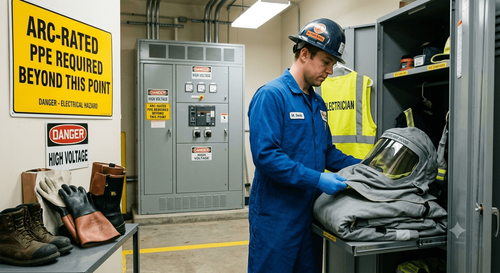
"You can demonstrate almost every industrial hazard safely at small scale. Arc flash is the exception.
An arc flash releases energy in milliseconds, at temperatures that exceed the surface of the sun, with a pressure wave capable of throwing an adult across a switch room. There is no scaled-down version. There is no controlled demonstration you can run for a training group. The entire hazard has to be taught through description, photographs of injuries, and incident case studies.
This is why electrical safety training has an unusual profile. Technicians can recite approach boundaries, incident energy categories and PPE requirements with precision, and still open a panel without verifying isolation, because the abstraction never became real.
VR is the first training medium that can put a technician inside an arc flash event and have them walk away.
Key takeaways
- Arc flash cannot be demonstrated physically, so it has always been taught abstractly, which is why compliance drifts.
- VR allows technicians to experience the consequence of a switching error without any exposure.
- Isolation, lockout verification, PPE selection and boundary discipline can all be assessed as decisions rather than exam answers.
- Live-panel scenarios can be run repeatedly on equipment that would otherwise require a shutdown to access.
- The training applies to operations, maintenance and contractor personnel, not only qualified electrical workers.
Where electrical safety programmes lose their grip
Most electrical safety failures fall into a small number of categories, and they are remarkably consistent across industries.
Verification skipped. The technician isolates, applies a lock, and proceeds without testing for absence of voltage, or tests with a meter that was never proved on a known live source.
Boundary encroachment. Someone enters the restricted approach boundary in ordinary work clothing because the task looked minor, or because they were only reaching in briefly.
PPE substituted. Arc-rated clothing is uncomfortable, hot, and slows work down. In practice a lower category is selected than the incident energy requires, or the face shield is left off for a task that takes thirty seconds.
Assumed de-energised. The panel was worked on yesterday. The label says spare. The drawing shows no supply. All three have killed people.
Every one of these is a decision made under time pressure, in a real environment, by someone who knows the rule. Classroom training addresses knowledge. These are not knowledge failures.
What the simulation puts in front of the learner
A VR electrical safety module recreates the actual electrical infrastructure the technician works on. The MCC room. The HV switchyard. The distribution boards on the production floor. Panel labelling, layout and equipment types match reality, because generic panels teach generic caution.
Within that environment, the learner works through complete task sequences:
- Permit and isolation. Identifying the correct isolation point from the single line diagram, confirming the upstream source, applying locks and tags in the right sequence.
- Proving dead. Selecting an appropriate tester, proving it on a known source, testing all conductor combinations, and proving the tester again. The system flags any step skipped.
- PPE selection. Reading the arc flash label, determining the incident energy, and selecting from the actual PPE available on site. Choosing wrong has a visible outcome.
- Approach boundaries. Movement within the simulation is tracked, so encroachment into a restricted boundary is recorded as an event, not a comment from an instructor.
- The consequence. When a critical error is made, the arc flash occurs. Learners experience the flash, the sound and the aftermath from a first-person perspective.
That last element deserves comment. There is a real debate about whether showing severe consequence in training is useful or gratuitous. In practice, a controlled and non-graphic depiction of an arc event, delivered once, with a debrief that walks the learner back through the decision chain, produces durable behaviour change. It converts an abstract category number into something with weight.
Beyond the qualified electrician
Electrical safety training is usually scoped narrowly to the electrical maintenance team. That scope leaves out most of the people who get hurt.
Production operators reset tripped breakers. Mechanical fitters open panels to reach a proximity switch. Cleaning crews wash down near energised equipment. Contractors arrive to install something and connect it to whatever is nearest. Instrumentation technicians work in cabinets that carry both control voltage and mains.
Each of these groups needs a different scope of electrical awareness, and VR makes it economical to deliver several tailored versions from a single environment. The operator module might cover recognising damaged equipment, understanding why a repeatedly tripping breaker is a warning rather than a nuisance, and knowing exactly where their authority ends. The contractor module covers site-specific isolation procedures and permit requirements before they touch anything.
Switching operations without a shutdown
For utilities, distribution companies and large industrial sites, HV switching competency is expensive to build. Real switching sequences happen on a schedule, under supervision, and a trainee might witness a handful of operations in a year.
In VR, a switching operation can be practised on the actual network model. The trainee reads the schedule, confirms the network state, carries out the sequence, applies earths, and deals with the deviations that make switching difficult: a discrepancy between the diagram and the field, an interlock that will not release, a communication failure with the control room mid-sequence.
Errors in a switching sequence are consequential in reality and instructive in simulation. A trainee who has back-fed a section in VR understands why the sequence matters in a way that reading the procedure does not deliver.
Measuring what was previously unmeasurable
Electrical competency assessment traditionally relies on written examination plus supervised observation. The examination measures recall. The observation is limited by how many tasks a supervisor can watch.
A VR programme records, for every learner and every attempt: whether isolation was verified, whether the tester was proved, PPE category selected against requirement, time spent inside approach boundaries, sequence errors, and whether the learner recognised planted anomalies such as an incorrect label or a missing earth.
For an EHS or electrical authority, that produces something new: a competency profile per technician, updated with every session, showing which specific steps degrade over time. Refresher training can then target the actual weakness instead of repeating the full course annually.
Fitting VR into the existing framework
Electrical safety is heavily governed by standards and statutory requirements, and VR does not displace them. Authorisation processes, competent person designations and permit systems all remain.
What changes is the middle of the training pathway. Theory stays in the classroom or e-learning. Practical skills on real equipment remain necessary for physical handling. VR occupies the space between them, where judgement is built: recognising hazards, sequencing tasks, selecting protection, and understanding consequence.
Sites that have made this shift typically report the same two outcomes. Technicians take isolation verification more seriously, and near-miss reporting around electrical work goes up before it goes down, because people start recognising conditions they previously walked past.
Frequently asked questions
Is showing an arc flash in VR too disturbing for trainees?
Well-designed modules depict the event without graphic injury imagery, and pair it with a structured debrief. The purpose is understanding, not shock. Learners consistently rate it as the most valuable part of the module.
Can VR training count towards electrical competency authorisation?
It supports the competency evidence base but does not replace statutory authorisation processes, which vary by country and sector. Most organisations use it as a required stage before practical assessment.
Does it work for both LV and HV?
Yes. LV modules typically focus on isolation discipline, panel work and PPE. HV modules focus on switching sequences, earthing and network state awareness.
How specific does the environment need to be?
Specific enough that technicians recognise the panels. Building from your actual layouts, labels and single line diagrams is what makes the training transfer.
If you want to see how your own switchgear and isolation procedures would translate into a simulation, EDIIIE can build a scenario from your drawings."