Fire Drills That Actually Prepare People: Emergency Evacuation Training in VR

"A scheduled fire drill measures how quickly people can walk to a car park. It measures almost nothing else.
Every industrial site runs fire drills. Most run them quarterly or half-yearly, announced in advance, in daylight, with no smoke, no heat, no blocked exits and no injured colleague on the floor. The alarm sounds, people file out, a marshal counts heads, and a time is recorded.
That number gets reported as evacuation performance. It is not. It is a measure of walking speed under ideal conditions.
The behaviours that determine whether an evacuation succeeds or fails are the ones a scheduled drill deliberately removes: deciding to leave at all, choosing a route when the nearest one is blocked, helping someone who cannot walk, resisting the pull back towards a workstation, and doing all of it with degraded visibility and rising noise.
VR is the only practical way to train those behaviours without setting something on fire.
Key takeaways
- Announced fire drills train compliance with a procedure, not decision-making under emergency conditions.
- The critical failure in real evacuations is delayed initiation, and drills never expose it.
- VR can introduce smoke, blocked exits, alarm confusion and casualties safely and repeatedly.
- Individual response data replaces a single site-level evacuation time as the performance measure.
- Fire extinguisher selection and use can be practised properly in VR, which most sites cover only by demonstration.
What actually goes wrong in real evacuations
Research into real building fires and industrial emergencies keeps surfacing the same pattern. The largest single loss of time is not movement. It is the delay before people start moving.
People hear an alarm and look for confirmation. They ask a colleague. They check whether anyone else is standing up. They finish the task they were doing. They collect a bag. In some cases they walk towards the hazard to see what is happening. In an industrial setting where nuisance alarms are common, this delay stretches further, because the workforce has been conditioned to treat alarms as probably nothing.
The second failure is route rigidity. People move towards the exit they know, usually the one they came in through, even when a closer exit is available and even when their habitual route is compromised. A scheduled drill reinforces this, because the drill route is always clear.
The third is that support requirements are invisible until the emergency. Who helps the colleague with a mobility limitation. Who checks the isolated store room. Who accounts for the contractor crew that arrived that morning and is not on any list.
None of these are addressed by an announced walk to the assembly point.
What a VR evacuation simulation adds
A VR emergency module reconstructs the actual facility. The learner starts at their own workstation, in their own building, with the layout they know. Then conditions change.
- The alarm sounds under ambiguity. Sometimes it is a drill. Sometimes there is visible smoke. Sometimes there is nothing but the alarm. The learner has to decide, and the system records how long they take.
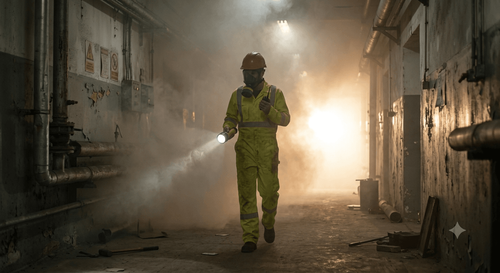
- Visibility degrades. Smoke fills corridors realistically, obscuring signage and forcing route decisions with incomplete information.
- Exits fail. A primary route is blocked. The learner must fall back to a secondary route they may never have used.
- Others are present. Colleagues who freeze, who move the wrong way, who need assistance. Social behaviour under stress is a large part of what determines outcomes.
- The clock is real. Fire spread and smoke propagation are modelled, so hesitation has a cost the learner can see.
Because none of this carries risk, it can be run repeatedly. A worker can experience twelve different evacuation scenarios in the time a physical drill takes to organise once.
Extinguisher training that goes beyond the demonstration
Most sites cover fire extinguisher use with an annual demonstration in the car park. A trainer lights a tray of diesel, a few volunteers discharge an extinguisher, everyone else watches.
That teaches the sweeping motion. It does not teach the decisions that matter: whether to fight the fire at all, which agent to select for the class of fire in front of you, where to stand relative to the exit, and when to stop and leave.
In VR, every worker can face an electrical fire, a solvent fire, a metal fire and a cooking oil fire, select from the extinguishers actually installed on their floor, and see the consequence of the wrong choice. Using water on an energised panel produces the outcome it produces. That lesson lands harder in simulation than in any slide.
The module can also cover the decision not to fight. A fire beyond incipient stage should be left alone, and workers are rarely trained to recognise that boundary.
Training the marshals separately
Fire marshals and emergency response team members need a different scenario set from the general workforce. Their decisions are coordination decisions: sweep sequence, headcount reconciliation, liaison with the shift in charge, escalation to external services, and managing people who want to go back inside.
VR handles this well because it can present incomplete and conflicting information. A marshal arrives at the assembly point with two people unaccounted for, one of whom left site at lunch and one of whom is genuinely inside. What happens next is a judgement, and judgement is trainable through repetition.
For sites with an on-site emergency response team, the same platform can carry hot work fire scenarios, chemical fire response, and coordination with mutual aid partners.
From site-level time to individual competency
The single most useful shift VR enables is measurement at the individual level.
A physical drill produces one number for the whole site. A VR programme produces, for each worker: time to initiate movement, route selected, whether the nearest exit was used, whether a blocked route triggered a correct fallback, whether assistance was offered, and whether the assembly point was reached.
That data identifies specific weaknesses. If the night shift consistently delays initiation, that is a specific finding with a specific intervention. If workers in one building never use the secondary stairwell, that is a wayfinding problem, possibly a signage problem, and it is now visible before an incident rather than after.
It also gives EHS leadership something to report that is genuinely meaningful, rather than an evacuation time that everyone knows is optimistic.
Practical deployment
Fire and evacuation modules are among the easiest VR training programmes to deploy, for three reasons.
They apply to the entire workforce rather than a specialist group, so utilisation of the hardware is high. They are short, typically ten to fifteen minutes per scenario, so they fit into shift changeovers and induction slots. And they build directly on a 3D model of the facility, which can be reused for other training and for operational purposes.
Most organisations start with a single building, run the whole workforce through it, compare the data against their last physical drill, and expand from there.
Physical drills do not go away. Statutory requirements remain, and there is value in exercising the physical assembly and roll-call process. But the drill becomes a verification of logistics, while the actual behavioural training happens in VR, where it can be repeated, varied and measured.
Frequently asked questions
Does VR training replace statutory fire drill requirements?
No. Statutory drill obligations remain in force. VR strengthens the behavioural preparedness that drills cannot deliver, and most organisations run both.
How realistic is the smoke simulation?
Modern real-time rendering handles smoke propagation and visibility loss convincingly enough to change behaviour. Learners consistently report disorientation and route uncertainty, which is the point.
Can it model our specific building?
Yes. Modules are built from architectural drawings, floor plans and site photographs so that the layout, signage and exit positions match the real facility.
How many scenarios do we need?
Most sites start with four to six variants covering different ignition points, blocked routes and time-of-day conditions, then add scenarios as findings emerge from the data.
If you want to see what your own facility looks like as an evacuation simulation, EDIIIE can build a scenario from your floor plans and show you."