Forklift and Material Handling Safety: Training the Pedestrian, Not Just the Driver

"Half the people injured by forklifts were never trained on forklifts. They were walking.
Forklift safety training in most organisations targets one population: licensed operators. They receive initial certification, periodic refreshers, and a practical assessment on the machine. This is appropriate and necessary.
It also leaves out everyone else. Production workers crossing an aisle. Maintenance technicians walking to a machine. Quality inspectors on the floor. Contractors passing through. Visitors. Store personnel loading a trolley.
A substantial share of forklift injuries involves someone on foot, and almost none of those people have received meaningful training on how to behave around a moving industrial vehicle. The reason is practical. You cannot run a training exercise where a forklift nearly hits somebody.
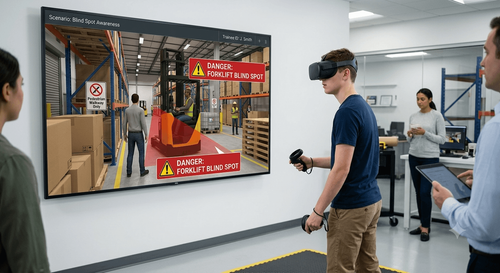
In VR, you can, and it works.
Key takeaways
- Forklift training targets drivers, while a large share of injuries involves pedestrians who receive none.
- Blind spots become comprehensible when experienced from inside the cab, which VR makes possible for non-drivers.
- Load stability and stability triangle behaviour can be demonstrated to failure without damaging anything.
- Near-miss scenarios can be rehearsed safely and repeatedly, which is impossible on a live floor.
- The same environment covers warehouse, manufacturing, ports and construction material handling.
Why the driver-only model breaks down
A forklift operator can be perfectly competent and still be involved in a serious incident, because the outcome depends on two parties.
The operator's field of view is obstructed by the mast, the load and the machine body. Reversing with an elevated or bulky load leaves large blind areas. Noise on the floor masks the approach. A pedestrian who steps out of a bay, walks in a marked aisle assuming right of way, or crosses behind a reversing truck is relying entirely on the operator seeing them.
Pedestrians consistently underestimate this. Ask a production worker how far a forklift travelling at walking pace needs to stop, and the answer is usually optimistic. Ask them what the operator can see when carrying a pallet at chest height, and most have never considered the question.
That misunderstanding is the root of the problem, and it is fixable through experience rather than instruction.
Putting the pedestrian in the cab
The single most effective element of a VR material handling module is also the simplest: put the non-driver in the operator's seat.
Once someone has driven a forklift in VR with a load obstructing forward view, reversed with a mirror as the only reference, and had a colleague appear from behind a rack with no warning, the abstract rule about staying visible becomes concrete. They stop walking behind trucks. They make eye contact before crossing. They stay out of the turning arc.
The reverse also works. Operators benefit from experiencing the incident from the pedestrian side, seeing how little warning a person on foot actually gets.
This perspective-switching is something no other training format can deliver, and it consistently produces the strongest behaviour change in material handling programmes.
What operators practise that they cannot practise on the floor
For licensed operators, VR adds scenarios that are unavailable in physical training because they involve deliberately creating dangerous conditions.
Load stability to failure. Learners can load beyond capacity, travel with an elevated load, turn on a gradient, and watch the machine tip. Understanding the stability triangle is much easier after seeing it violated. Doing this physically writes off equipment and risks injury.
Ramp and gradient handling. Travelling up and down with a load, the correct direction of travel, and what happens when it is wrong.
Racking interaction. Placing and retrieving at height, recognising damaged racking, understanding the consequences of an impact on a loaded rack, and rack collapse propagation.
Trailer and dock operations. Loading a trailer with unverified wheel chocks or restraint, trailer creep, and dock-edge falls, which are among the most severe outcomes in warehouse operations.
Surface and environment variation. Wet floors, uneven yard surfaces, poor lighting, congested aisles at shift change.
Pre-use inspection. A machine can be seeded with defects, from a low tyre to a leaking hose to a defective horn, and the learner has to find them within a realistic inspection window.
Beyond forklifts
Material handling is broader than counterbalance trucks, and the same environment usually extends to the rest of the fleet.
Reach trucks and VNA equipment introduce different visibility and stability characteristics. Order pickers add work-at-height considerations. Pallet trucks and powered pallet movers are involved in a high volume of low-severity injuries that add up. In ports and heavy industry, the same principles apply to reach stackers, straddle carriers and terminal tractors. On construction sites, telehandlers introduce load charts and boom geometry.
For manual handling, VR is genuinely useful for teaching lifting technique with real-time posture feedback, which is difficult to deliver at scale with human observers.
Traffic management as a system
The most valuable output of a VR material handling programme is often not individual competency but insight into the traffic management plan itself.
When a whole shift runs through the same simulated environment, patterns emerge. If most pedestrians take a shortcut across a vehicle route at a particular point, that is a design finding. If operators consistently have poor visibility at one junction, the mirror or the layout needs to change.
Because the environment is a model of the real floor, proposed changes can be tested before they are implemented. Moving a pedestrian walkway, adding a barrier, changing a one-way direction or repositioning a racking aisle can be evaluated in simulation, with real workers walking and driving through the revised layout, in a fraction of the time and cost of a physical trial.
Deployment that fits a working floor
Material handling modules have an unusual advantage: they are short and they apply to almost everyone on site.
A pedestrian awareness module runs eight to twelve minutes. It fits into a shift briefing slot, a new starter induction, or a contractor sign-in. A single headset can process an entire shift over a few days without disrupting production.
Operator modules are longer, typically twenty-five to forty minutes, and are usually structured as a guided learn mode followed by an assessed run. They do not replace the physical practical assessment required for certification, but they substantially reduce the time needed on the machine, because the learner arrives already understanding the sequence.
Frequently asked questions
Does VR replace practical forklift certification?
No. Practical assessment on the actual machine remains necessary. VR reduces the time required for it and covers scenarios that cannot be assessed physically.
Is a VR forklift module the same as a motion-platform simulator?
No. Motion platforms replicate machine feel for skill development. VR headsets are better suited to hazard perception, decision-making and scenario variety, at a much lower cost per station.
Who should take the pedestrian module?
Anyone who walks on a floor where powered vehicles operate. Production, maintenance, quality, stores, office staff who cross the floor, and all contractors and visitors.
Can it model our actual warehouse layout?
Yes. Modules are built from site layouts and photographs so that aisles, racking, dock positions and traffic routes match the real facility.
If you want to see your own floor layout as a training environment, including the junctions you already suspect are a problem, EDIIIE can build it and show you what your workforce does in it."