Multilingual VR Training for India's Frontline Workforce

"A safety instruction that is understood partially is not a safety instruction. It is a hope.
Walk through a large Indian manufacturing plant and count the languages on the floor. In a single facility you might find Hindi, Marathi, Bengali, Odia, Telugu, Tamil, Bhojpuri and several more, spoken by workers who migrated for the job and who understand English signage and English training material to widely varying degrees.
Now look at the training material. In most organisations it is in English, possibly with a Hindi version. Delivery is often by an instructor translating on the fly, with accuracy that depends on their own fluency and their understanding of the technical content.
This is a real and largely unaddressed safety gap. Not because organisations do not care, but because producing high-quality training in eight languages has historically been expensive enough that it never quite got approved.
The economics of that changed when training moved into simulation.
Key takeaways
- Multilingual industrial workforces are the norm in India, and English-first training excludes a large part of them.
- Instructor-led translation introduces variability exactly where consistency matters most.
- VR is inherently visual, which reduces language dependence before any translation happens.
- Localising a VR module is a narration and interface exercise, not a rebuild.
- Comprehension can be measured per language, which no other format allows.
Why translation alone has not solved it
Organisations that have tried to localise safety training usually encounter the same three problems.
Technical vocabulary does not translate cleanly. Many industrial and safety terms have no established equivalent in regional languages, or have several competing ones. A literal translation can be technically wrong in a way that matters. Getting this right requires someone who understands both the language and the process, which is a narrow pool.
Written material assumes literacy that is not universal. A translated document helps a worker who reads that language fluently. It does less for a worker whose literacy in any language is limited, which is a significant population in frontline roles.
Instructor translation is inconsistent. An instructor rendering English content into Bhojpuri in real time will emphasise differently each time, and will simplify the parts they find hardest to express. The workers who most need precision receive the least of it.
The result is a training system that is formally compliant and functionally uneven.
Why VR reduces the problem before translation begins
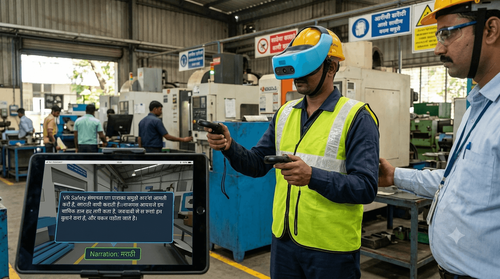
The most important thing about VR in a multilingual context is that a large part of the instruction is not verbal at all.
A worker sees the equipment. They see the hazard. They see the consequence of an incorrect action. They perform the sequence with their hands. Spatial and procedural learning happens through doing, and doing does not require language.
This is a genuine difference from document and lecture-based training, where language carries almost the entire load. In a well-designed VR module, language carries context, nuance and reasoning, while the core procedural learning is demonstrated and practised.
That means even an imperfectly localised module transfers better than a perfectly translated document, and a properly localised one transfers very well.
What localisation actually involves
The economics are favourable because the expensive part of a VR module is built once.
The 3D environment, the equipment models, the interaction logic, the scenario design and the assessment criteria are language independent. What changes per language is narration audio, on-screen text and interface labels, and any text within the environment such as signage and labels.
That is a fraction of the total build cost. Adding a language is typically a small percentage of the original development, which is why organisations that would never approve eight versions of a training film routinely approve eight language tracks for a VR module.
The work that deserves care is terminology. Building a technical glossary with people who know both the language and the process, before recording begins, prevents the most common failure mode, which is fluent narration that says something subtly wrong.
Voice quality matters more than people expect. A flat, mechanical narration reduces engagement in any language. Native speakers with an appropriate register, ideally with some familiarity with industrial work, produce noticeably better outcomes than a generic voiceover.
Design choices that help
Beyond translation, a few design decisions make modules substantially more accessible.
Minimise text. Where an instruction can be shown rather than written, show it. Icons, highlighting, spatial arrows and demonstrations reduce reliance on reading.
Allow language switching at any point. A worker may be more comfortable with instructions in one language and technical terms in another. Letting them switch mid-session, without restarting, removes a barrier.
Let learners repeat instructions. A replay control on narration costs nothing and helps anyone working in a second language.
Do not compress complexity. Simplified language is good. Simplified content is not. A worker who speaks Odia rather than English needs the same technical depth, not a reduced version.
Allow for pace. Comprehension in a second language takes longer. Timed assessments should account for this or they measure language proficiency rather than competence.
Something you can measure for the first time
The most interesting consequence of multilingual VR is that comprehension becomes measurable by language group.
If workers taking a module in one language consistently underperform on a particular step, that is a specific and fixable finding. It might be a translation problem. It might be a terminology problem. It might be that the concept needs a different explanation in that language.
Traditional training cannot detect this at all. Everyone signs the same attendance sheet regardless of what they understood.
Organisations that have looked at this data have generally found gaps they did not know existed, in populations they assumed were adequately covered. That alone tends to justify the localisation investment.
The wider case
There is a compliance argument. Safety regulations in most jurisdictions require that training be understood, not merely delivered, and an organisation that trains a Telugu-speaking workforce exclusively in English has a weak position after an incident.
There is an operational argument. Errors caused by misunderstood instructions cost quality, output and rework, not only safety.
And there is a straightforward argument about the workforce. Delivering training in someone's own language communicates that their understanding matters. In sectors competing for skilled frontline labour, that is not a small thing.
Frequently asked questions
How many languages should we support?
Start with the languages spoken by the largest groups in your workforce, which most HR functions can identify from existing records. Three to five usually covers the majority in a typical Indian plant.
Can we add languages after the module is built?
Yes, provided the module was designed with localisation in mind, with text and audio separated from the core logic. Confirm this with your developer before build, not after.
Does this apply to international operations too?
Yes. The same architecture supports global rollouts where a group operates across multiple countries.
How do we handle technical terms with no regional equivalent?
Build a glossary with technical and language expertise together, and where no good equivalent exists, retain the English term with a clear explanation on first use rather than inventing one.
If you want to understand what localising your existing safety training into the languages your workforce actually speaks would involve, EDIIIE can scope it with you."