Cutting Onboarding Time on the Shop Floor: What VR Does for New Hires

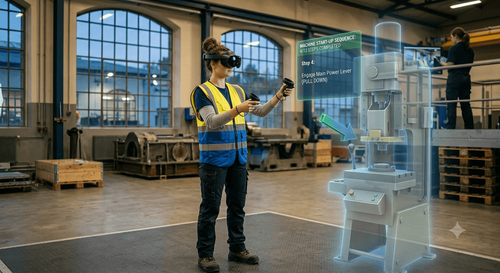
"Ask a plant manager how long a new operator takes to become fully productive. Then ask what happens during those months. The second answer is usually vaguer than the first.
Most manufacturing onboarding follows a familiar shape. A day or two of induction covering HR, safety and site rules. Then the new hire is assigned to an experienced operator and learns by watching, helping, and gradually taking over tasks under supervision.
This works. It has worked for a century. But it has three costs that are rarely counted properly.
The first is the productivity of the experienced operator, who is now training instead of producing, at reduced output, for weeks.
The second is inconsistency. What the new hire learns depends entirely on who they were paired with, including that person's habits, shortcuts and blind spots.
The third is risk exposure. The new hire is on the floor, near operating equipment, during precisely the period when their hazard recognition is weakest.
Key takeaways
- Shadowing consumes an experienced operator's output for weeks and produces inconsistent results.
- New hires are most exposed to risk during the period when their hazard recognition is weakest.
- VR lets new starters build task familiarity before entering the production environment.
- Ramp-up time is a measurable metric, and it is usually the strongest number in the business case.
- The same content works for line transfers, returns from long absence and seasonal hiring.
What actually takes the time
Break down what a new operator needs to acquire and it separates into distinct categories.
Environmental familiarity. Where things are. Which door leads where. Where the isolation points, emergency stops, fire points and assembly areas are. This is pure orientation, and it is entirely learnable in a virtual model of the plant.
Procedural knowledge. The sequence of a task. Startup, changeover, quality check, shutdown, cleaning. Sequences are learnable in simulation and, once learned, do not need to be learned again on the machine.
Hazard recognition. Knowing what to look at and what a problem looks like before it becomes one. This is the part traditional onboarding delivers worst, because it depends on exposure to abnormal conditions that are rare by design.
Physical skill. Hand feel, force, dexterity, tool handling. This genuinely requires the real machine, and VR does not replace it.
Social and organisational knowledge. Who to ask, how escalation works, what the shift culture expects. Partly trainable, largely acquired.
Of those five, three can be substantially front-loaded into simulation. What arrives on the floor afterwards is a person who knows where they are, knows the sequence, and knows what to watch for. The experienced operator's time is then spent on physical skill and judgement rather than orientation.
What a VR onboarding programme looks like
A typical structure runs across the first week.
Plant orientation. A guided walkthrough of the facility, delivered before the new hire sets foot in it. Layout, area functions, restricted zones, emergency infrastructure, traffic routes. Twenty minutes in VR replaces a chaotic first-day tour where nothing is retained.
Safety induction. Site-specific hazards presented in the locations where they occur, rather than as a slide deck. PPE requirements by zone, permit systems, LOTO basics, emergency response.
Equipment familiarisation. The specific machines the new hire will work on. Controls, guards, interlocks, normal operation, and what abnormal looks like.
Task sequences. Guided walkthrough of each core task, then unguided repetition until it is reliable, then an assessed run.
Abnormal conditions. The compressed experience layer. A jam, a quality drift, an alarm, an unexpected stop. Conditions that would take months to encounter naturally, delivered in a morning.
Quality and standards. What a good part looks like, what a defect looks like, and what to do when the two are close together.
The number that makes the case
The metric that carries the argument internally is time to independent working, or time to standard output. Most plants can produce it from existing records, or estimate it credibly from supervisor input.
Once you have the baseline, the calculation is simple. If a new operator currently reaches independent working in ten weeks, and the cohort trained with VR reaches it in seven, the value is three weeks of a supervisor's or senior operator's partial time plus three weeks of earlier full output, multiplied by the number of new hires per year.
For a plant hiring fifty operators a year, that number gets large quickly, and it is a number the finance function recognises without translation.
Two secondary metrics usually strengthen it. First-quarter incident rate among new hires, which is typically elevated and typically falls. And early attrition, which is influenced by how supported and competent people feel in their first month.
Where it applies beyond new hires
Onboarding content built once serves several other populations.
Line and role transfers. An experienced operator moving to a different line faces the same procedural learning curve, without the environmental one.
Return from extended absence. Skills degrade. A short refresher in simulation is far better than assuming competence carried over.
Seasonal and temporary workforces. Where hiring is cyclical, the ability to bring a large group to a consistent standard quickly is the difference between a smooth ramp and a difficult one.
Contractors. Site-specific induction with an auditable record, delivered consistently regardless of which contractor is providing the labour.
New plants and expansions. Perhaps the strongest case of all. Operators can be trained on a plant that does not physically exist yet, using the engineering model, so that commissioning starts with a trained workforce instead of a learning one.
What this does to the experienced operator's role
There is a version of this conversation that goes badly, where experienced staff perceive VR as a replacement for their expertise. It is worth heading off directly, because their cooperation determines whether the programme works.
In practice their role improves. They stop spending three weeks explaining where the toilets are and what the machine does, and start spending their time on the judgement and technique that only they can teach. Many are also the right people to build the content with, since scenario development requires exactly the knowledge they hold, and being consulted as the authority on how the job is really done changes how the programme is received on the floor.
Frequently asked questions
How much does VR actually reduce ramp-up time?
Reported reductions vary by role complexity, commonly in the range of twenty to forty percent for procedural roles. The honest answer is that you should measure your own baseline first and treat any vendor number as an indication rather than a promise.
Does this remove the need for on-job training?
No. Physical skill and judgement still develop on the machine. VR shortens the phase before that, and makes the on-job phase more productive.
Is it worth it for a plant hiring only a few people a year?
Usually not as a standalone onboarding case. It becomes worthwhile when the same content also serves safety training, refreshers and contractor induction.
What about older workers who are unfamiliar with VR?
Adoption is generally straightforward across age groups when the module is well designed and the briefing is done properly. The interaction model matters more than the learner's age.
If you want to model what a shorter ramp-up would be worth at your plant, EDIIIE can work through the numbers with your production and HR data."