Connecting VR Training to Your LMS: What xAPI Actually Gives You

"If your VR training does not report into the system your organisation already uses, you have built a second training record. That is a problem, not a feature.
Most VR training pilots run standalone. A headset, a module, a facilitator with a clipboard. Completion gets recorded manually and typed into the LMS later, or not at all.
This is acceptable for a pilot with twenty people. It fails immediately at scale. When two thousand workers across six sites are training in VR, manual reconciliation becomes a job nobody wants, the data is late, and the compliance record has a gap that an auditor will eventually find.
Integration is not a technical detail to sort out later. It determines whether VR training becomes part of how the organisation trains, or stays a demonstration that impressed everyone and then quietly stopped.
Key takeaways
- Standalone VR training creates a parallel record that breaks compliance reporting at scale.
- SCORM records completion. xAPI records what the learner actually did, which is the entire point of VR.
- A learning record store is what makes VR data useful, and it usually sits alongside rather than inside the LMS.
- Decide what you want to measure before the module is built, because instrumentation is a design decision.
- Single sign-on and device management matter as much as data reporting for real deployments.
SCORM and xAPI, and why the difference matters here
Most corporate LMS platforms speak SCORM. SCORM was designed for browser-delivered e-learning and reports a small, fixed set of things: completed or not, passed or failed, a score, and time spent.
For a slide-based module, that is adequate. For VR, it discards almost everything valuable. A SCORM record tells you an operator completed the LOTO module with a score of eighty-five percent. It cannot tell you that they skipped the try-out step twice, took forty seconds to locate the isolation point, and selected the wrong lock on their first attempt.
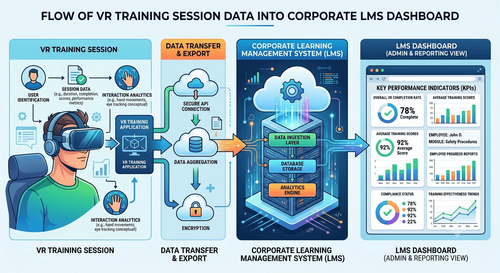
xAPI, sometimes called Tin Can, was designed for exactly this. It records statements in the form of actor, verb and object, with as much context as you want to attach. A single VR session might generate hundreds of statements: which hazards were identified, in what order, how long each decision took, which errors were made and whether they were corrected.
Those statements go to a learning record store, which is a database designed to hold and query them. Some modern LMS platforms include one. Many do not, in which case the LRS sits alongside the LMS.
The practical arrangement most organisations end up with is this. xAPI statements flow to an LRS for detailed analysis. A summary result, usually completion and score, flows to the LMS for compliance reporting. The LMS remains the system of record for who has been trained. The LRS becomes the source for understanding how well.
Deciding what to measure
The most common mistake is building the module first and asking about data afterwards. Instrumentation is a design decision, and retrofitting it means rework.
Before development starts, be specific about what you want to know. Useful categories:
Completion and compliance. Who completed what, when, and did they pass. Non-negotiable, and the LMS needs it.
Performance detail. Errors by type and frequency, time on critical steps, attempts required to reach competency, and which specific steps are most commonly failed.
Behavioural signal. Where the learner looked, what they inspected before acting, whether they checked before proceeding, hesitation at decision points. This is where VR data is genuinely unique.
Progression. Improvement across attempts, and skill degradation between the initial session and the refresher.
Aggregate patterns. By site, shift, role, tenure and supervisor. This is where organisational findings surface rather than individual ones.
That last category is worth emphasising. When eighty percent of one site's operators fail the same step, it is not eighty individual training failures. It is a procedure, equipment or supervision issue, and the data found it.
The privacy conversation, held early
VR captures a lot. Head position, gaze direction, hand movement, timing, hesitation. Some of it is highly granular and some of it feels personal.
Handle this openly and up front, because if the workforce concludes that VR is a surveillance tool, adoption collapses and no amount of good design recovers it.
The principles that work: be explicit about what is captured and what is not. Use aggregated and anonymised data for programme improvement. Restrict individual performance data to the training and competency purpose it was collected for. Establish clearly whether an individual's failed attempts are visible to their supervisor, and be consistent about it. In many jurisdictions, including under Indian data protection law, biometric-adjacent data carries specific obligations, so involve the people who own that question rather than deciding it in the training team.
Organisations that treat failed attempts as learning rather than as a performance record get better data, because learners stop gaming the assessment.
The other integrations that matter
Data reporting is one part. Three others determine whether deployment is smooth or painful.
Identity. Learners should not be typing employee numbers into a headset with a virtual keyboard. Single sign-on, badge scanning or a paired mobile app removes friction and, more importantly, prevents the record-keeping errors that come from mistyped identifiers.
Device management. At scale you need a mobile device management platform for the headsets, handling content distribution, updates, kiosk mode, configuration and remote troubleshooting. Manually side-loading updates onto forty headsets across four sites is a job that will be done badly.
HR and competency systems. Training requirements are usually driven by role. Integrating with the HRIS so that a role change automatically triggers the correct training assignment, and a competency expiry automatically triggers a refresher, is what makes the programme self-sustaining rather than dependent on someone remembering.
Questions to put to a vendor
When evaluating VR training providers, these questions separate a genuine platform from a demonstration.
Does the module emit xAPI, and can we see the statement structure before development starts. Which LMS platforms have you integrated with in production, not in principle. Do we get access to the raw data or only your dashboard. If we stop working with you, what happens to our training data and in what format do we get it. How is device management handled and does it work with the MDM we already use. How does authentication work in practice on the floor.
The data ownership question is the one most often skipped and most often regretted.
Frequently asked questions
Do we need an LRS, or can our LMS handle xAPI?
Some modern LMS platforms include an LRS. Many older enterprise platforms do not. Check specifically for xAPI statement storage and querying, not just xAPI support in marketing material.
Can VR modules work with SCORM if that is all our LMS supports?
Yes, with a wrapper that reports completion and score. You lose the detailed behavioural data unless an LRS is added alongside.
How much data does a VR session generate?
A twenty-minute session can produce several hundred xAPI statements depending on instrumentation. Storage is not usually the constraint; deciding what is worth analysing is.
Should integration happen during the pilot or after?
Design for it during the pilot, even if you implement a simplified version. Retrofitting instrumentation into finished modules is expensive.
If you are planning a VR training programme and want the data architecture settled before development begins, EDIIIE can work through the integration design with your L&D and IT teams."