VR Safety Training for Mining Operations: Underground Competence Without Underground Risk

"In mining, the place where competence matters most is the place you can least afford to use as a classroom.
Mining training has always been shaped by a hard constraint. The workface is productive, hazardous and remote. Taking a group of new recruits underground to demonstrate strata behaviour, ventilation failure or a machinery interaction hazard is slow, expensive and, for the scenarios that matter most, impossible.
So training gets pushed to the surface. A model gallery. A classroom with photographs. A simulator for a specific machine, if the operation is large enough to justify one. New recruits then learn the real thing by working alongside experienced miners, which is effective but slow, and increasingly difficult as experienced workforces retire faster than they are replaced.
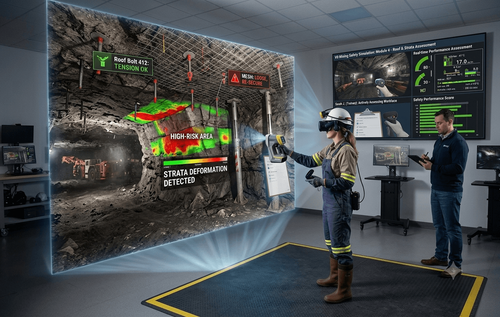
Immersive VR changes the constraint. The workface becomes something you can enter as often as you need, in any condition, with any hazard present.
Key takeaways
- Mining competence has always been limited by access to the workface, and VR removes that limit.
- Hazards that cannot be demonstrated safely, such as strata failure or ventilation loss, become trainable.
- Machinery interaction and blind-spot awareness can be practised from both operator and pedestrian perspectives.
- Emergency response, including self-rescuer use and escape routes, can be rehearsed under realistic conditions.
- Consistent scenarios help standardise competency across contractor and multi-site workforces.
What mining training cannot currently reach
Ask any mine safety officer which hazards their training programme covers well, and which it covers only on paper. The answers are consistent.
Covered well: statutory content, machine-specific operation, standard operating procedures, PPE, first aid.
Covered on paper: strata and ground condition assessment, ventilation failure response, inundation, fire underground, entrapment and escape, gas ingress, and every scenario where the correct response is time-critical and the wrong response is fatal.
The reason is straightforward. You cannot create a roof fall to teach roof fall recognition. You cannot cut ventilation in a working section to teach gas accumulation response. You cannot start a conveyor fire to see whether a crew evacuates correctly.
These are exactly the events that kill people, and they are the ones the training system reaches least.
What a VR mining module covers
A mining VR programme is usually built around the specific operation, because underground layouts, seam conditions, equipment fleets and ventilation designs differ enormously between mines.
Strata and ground control. Learners inspect a workface, identify indicators of instability, assess support adequacy and decide whether to proceed. Ground conditions can be varied so that no two sessions present the same picture, forcing genuine assessment rather than memorised answers.
Ventilation and gas. Airflow becomes visible in the simulation, which is one of the more effective teaching tools available. Learners see what happens to methane accumulation when a stopping is damaged or an auxiliary fan fails, and how quickly conditions change in a heading.
Machinery interaction. Continuous miners, shuttle cars, LHDs, dump trucks and shovels are among the largest sources of mining fatalities. VR lets learners experience the same interaction from inside the cab and from the pedestrian's position, which is the fastest way to make blind spots comprehensible.
Opencast hazards. Bench stability, edge protection, haul road interaction, tip-head procedures and dump truck operation around the crest.
Emergency response. Self-contained self-rescuer donning under stress and degraded visibility, refuge chamber location and use, escape route navigation when the primary route is compromised, and communication with the surface.
Statutory and permit work. Blasting exclusion zones, isolation of equipment, confined space entry into bins and chutes, and hot work underground.
The self-rescuer problem
Every underground miner is trained to don a self-rescuer. Most are trained on a training unit, on the surface, standing still, in good light, with an instructor talking them through it.
In an actual emergency they will be doing this in the dark, in smoke, breathing hard, possibly having already inhaled contaminated air, with a device that is uncomfortable and produces heat when it activates. The failure modes are well documented: incorrect seal, removal because of the heat, and delay while trying to locate the device.
VR does not replace physical self-rescuer training, and cannot simulate the physical sensation of the device. What it can do is train the surrounding decisions. When to don. Where the nearest cache is from the current position. Which route to take. What to do when the route is blocked. How long the device lasts and what that means for route choice. Those decisions are where most of the survivable time is lost.
Training a workforce that keeps changing
Indian mining operations, both public sector and private, run substantial contractor workforces. Contractor crews rotate, arrive with varied backgrounds, and often receive a compressed induction because production cannot wait.
This is where standardised VR induction has an immediate operational effect. A contractor arriving on Monday can be taken through the actual mine layout, the specific hazards of the section they will work in, the escape routes from that section, and the site-specific procedures, before they go underground for the first time. The content is identical for every worker, and the assessment record is auditable.
For multi-mine operators, the same approach removes site-to-site variation in induction quality, which is one of the harder things to control in a distributed operation.
What the data gives the safety department
Mining safety departments generally have good lagging indicator data and weak leading indicator data. Incident and injury numbers are recorded meticulously. Competency is recorded as pass or fail on a training register.
Simulation adds a layer between these. For each learner: whether unstable ground indicators were identified, how long assessment took, whether support adequacy was correctly judged, response time to a gas alarm, route selected during escape, and whether self-rescuer donning was initiated within the safe window.
Patterns in that data are actionable. If most of a section's crew fails to identify a particular strata indicator, the intervention is specific and immediate.
Practical considerations for mining deployments
A few things matter more in mining than in other sectors.
Hardware environment. Training is usually delivered at the surface training centre rather than underground, which simplifies hardware management considerably. Standalone headsets with a managed device platform work well.
Language. Mining workforces in India are frequently multilingual. Narration and interface localisation into the languages actually spoken at the mine matters more here than in most industries.
Literacy assumptions. VR is a strong fit where written material is a barrier, because instruction can be delivered visually and through narration rather than text.
Statutory alignment. VR supports competency development but sits alongside, not instead of, statutory training and certification requirements. Positioning it clearly as a supplement avoids friction during audits.
Where to start
The most common starting point is a single high-consequence scenario set built around the operation's own incident history, delivered at the training centre, run first with new recruits and contractor inductions.
That gives a measurable comparison group within a few months. If the induction cohort trained in VR shows faster time to independent working and fewer procedural errors in their first quarter, the case for expansion writes itself.
Frequently asked questions
Does VR training satisfy statutory mining training requirements?
It supplements them. Statutory training and certification requirements remain in force, and VR is typically positioned as an additional competency assurance layer.
Can it model our specific mine?
Yes. Underground and opencast environments are built from survey data, mine plans and site photography so that layouts, equipment and conditions match the actual operation.
Is it suitable for opencast as well as underground?
Yes. Opencast modules typically focus on haul road interaction, bench and tip-head stability, heavy vehicle blind spots and blasting exclusion procedures.
How do we handle a workforce with mixed language and literacy levels?
Modules are built with multilingual narration and visual instruction, which generally makes them more accessible than written training material.
If you want to see how your own mine layout and hazard profile would translate into a training simulation, EDIIIE can build a scenario from your mine plans."