VR Training for Power Plants and Substations: Competence for Assets You Cannot Take Offline

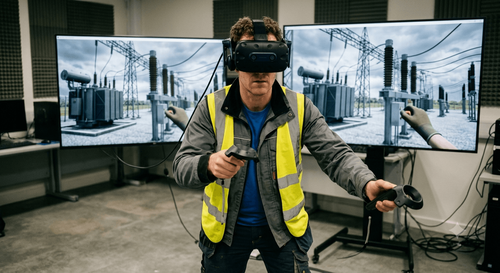
"Power assets run continuously by design. That makes them exceptionally difficult to train on.
A generation unit is expected to be available. A substation is expected to be energised. A transmission line is expected to carry load. The entire economic logic of the sector rewards availability, which means the periods where equipment is accessible for hands-on training are narrow, scheduled far ahead, and fully occupied by actual maintenance work.
The consequence is a training model built around scarcity. Trainees observe more than they perform. Switching competence accumulates over years, one supervised operation at a time. Emergency response is exercised through documents and occasional drills. And a substantial portion of institutional knowledge sits with staff who are approaching retirement, in a sector where that demographic cliff is arriving faster than replacements can be developed.
VR does not solve every part of this. It solves the part where practice is impossible.
Key takeaways
- Training opportunities in power are constrained by availability requirements, not by training budgets.
- Switching sequences, earthing and network state awareness can be practised on a network model without an outage.
- Emergency and abnormal scenarios that cannot be created on a live system become trainable.
- Renewables introduce new hazard profiles that traditional training programmes have not caught up with.
- Simulation captures retiring expertise as reusable scenarios rather than losing it.
Thermal generation
In a thermal plant, the highest-value training scenarios are the ones that cannot be created deliberately. Tube leak identification. Turbine trip response. Loss of a feed pump. Boiler flame failure. Load rejection. Blackstart.
Operators handle these rarely, which is the objective, and which is also why response quality is uneven. A control room team that has never worked a load rejection together will not perform one well the first time.
Immersive simulation covers three areas the DCS training simulator does not. It covers the field operator, who has to reach equipment physically and whose actions the panel operator depends on. It covers the physical plant environment, including the noise, the layout and the access constraints that determine how long anything takes. And it covers coordination between control room and field, which is where the timing failures occur.
For maintenance, VR handles the procedures that only happen during a shutdown: turbine overhaul sequences, boiler internal inspection, generator rotor work, valve overhauls. A technician who performs a task once every two years during a compressed outage window benefits enormously from rehearsing it beforehand.
Transmission and distribution
Substation work concentrates on switching, earthing and access control, and the failure modes are well documented: operating the wrong equipment, incomplete earthing, working on the wrong bay, and proceeding on an assumed network state.
VR trains switching against a model of the actual network. Trainees read the switching schedule, confirm the state, execute the sequence and apply earths, with the system tracking every operation and its effect on the network model. Errors produce their real consequences: a back-feed, an unearthed section, an interlock violation.
The scenarios worth building are the ones that go wrong. A discrepancy between the diagram and what is in the yard. An isolator that fails to fully open. A communication loss with the control centre mid-sequence. A colleague who tells you the section is dead. These are the conditions under which real incidents happen, and none can be arranged for training on an energised system.
For distribution field crews, the same environment covers pole-top work, LT and HT line work, live-line procedures, and public safety scenarios such as a fallen conductor with bystanders present.
Renewables
Wind and solar have introduced hazard profiles that many organisations are still building competence for, often with young workforces and rapid hiring.
Wind turbine work combines confined space, work at height, electrical hazards, mechanical energy and rescue difficulty in a single asset, in a location where help is far away. Nacelle access, hub entry, blade inspection, converter work and, above all, rescue from height inside a tower are all high-consequence and all difficult to train on. A turbine used for training is a turbine not generating.
Solar introduces a hazard that is frequently underestimated: DC arc flash from strings that remain energised whenever there is light, with no way to switch them off. Combiner box work, inverter maintenance and module handling all need to be trained around that fact.
Battery storage is newer still, and thermal runaway response is something almost nobody has practised.
Capturing what is about to walk out the door
The workforce demographics in power utilities, particularly in the public sector, create a specific and urgent problem. A generation of engineers and technicians who commissioned and operated these assets for decades are retiring, and much of what they know was never written down.
Simulation offers a way to capture some of it. The process of building a scenario requires sitting with the people who know how the plant actually behaves, extracting the failure modes they have seen, the deviations from the written procedure that experience taught them, and the early indicators they watch for. That knowledge goes into the scenario library and remains available after they leave.
This is worth treating as a deliberate programme rather than a side effect. Several utilities have found the scenario-building interviews as valuable as the resulting training.
Contractor and multi-site consistency
Power operations rely heavily on contractors, particularly for maintenance, construction and line work. Contractor competence is variable, contractor induction is often rushed, and contractor incident rates are typically higher than for direct employees.
A standardised VR induction, covering site-specific hazards, isolation procedures, permit requirements and emergency arrangements, gives every contractor the same starting point with an auditable record. For utilities managing hundreds of sites, it also removes the variation that comes from every site running its own induction differently.
Building the business case in a regulated environment
Power utilities operate under tariff and regulatory frameworks that shape how investment is justified. The arguments that tend to carry weight are specific.
Availability protection, since training that does not require an outage removes a scheduling constraint. Safety performance, since incident reduction has both human and regulatory consequences. Time to competence, which matters acutely where a hiring wave is under way. And audit evidence, since demonstrating verified competence rather than attended training is increasingly expected.
The clearest starting point is usually a single high-value scenario set: switching for one substation type, or one critical maintenance procedure that recurs across the fleet. Build it, measure time to competence against the existing method, and use that comparison to scope the next phase.
Frequently asked questions
Can VR integrate with our existing simulator or SCADA?
Yes. Integration with dynamic process models, emulated DCS and network models is common, so that actions in VR produce realistic system behaviour.
Is it suitable for both generation and T&D?
Yes, though the scenario design differs. Generation focuses on plant operation and outage maintenance. T&D focuses on switching, earthing and network state.
How do we handle multiple substation designs across a network?
Modules are usually built around representative designs, with variants added for the configurations that differ materially. Building every site individually is rarely necessary.
Does it help with renewables where we have limited internal expertise?
It is often most valuable there, because the workforce is new and the assets are the hardest to access for training.
If you want to explore what a switching or outage maintenance scenario would look like on your own assets, EDIIIE can build a working example."