Working at Height Training in VR: Why Toolbox Talks Are Not Enough

"Every worker who has fallen from height had completed the training. That is the uncomfortable part.
Falls from height remain one of the largest contributors to fatal industrial accidents in India, across construction, power, cement, steel and oil and gas. The response in most organisations is well established: a work-at-height policy, a permit system, a harness inspection checklist, and a toolbox talk before the shift begins.
None of that is wrong. All of it is necessary. And yet the incident data barely moves. Workers who can correctly answer every question about anchor points and fall factors still clip onto handrails. Supervisors who have signed hundreds of permits still approve jobs where the rescue plan exists only on paper.
The gap is not knowledge. It is the distance between knowing a rule in a classroom and applying it forty feet above a running plant, in the wind, with a job to finish before the shift ends. VR is the only training format that closes that distance without putting anyone at risk.
Key takeaways
- Work-at-height incidents are usually behavioural failures, not knowledge failures, so knowledge-based training does not fix them.
- Height exposure creates a physiological response that classroom training cannot simulate, and that response is what determines behaviour on site.
- VR lets workers make anchor point, harness and access decisions under realistic height stress, repeatedly, with zero consequence.
- Rescue-at-height planning is the most neglected element of most programmes and the easiest to practise in VR.
- Competency data from VR gives EHS teams evidence of decision-making quality, not just attendance.
Why the standard programme keeps failing
A conventional work-at-height programme teaches five things: hazard identification, equipment selection, inspection, anchor point selection and rescue. It teaches them through slides, a demonstration harness, and if the organisation is well resourced, a low-level practical rig in the training centre.
The problem is that all five of those decisions are made differently when the worker is actually exposed. Height changes physiology. Heart rate rises, peripheral vision narrows, and the brain begins optimising for speed rather than procedure. A worker who calmly identified three valid anchor points in a classroom will, on a live structure, clip onto whatever is closest and looks strong enough.
Training on a two-metre practical rig does not trigger that response. Training at actual height, on a live structure, triggers it but is unacceptable for a first-time learner. This is the trap that work-at-height training has been stuck in for decades: the only environment that produces realistic behaviour is the one you cannot practise in.
What height exposure in VR actually does
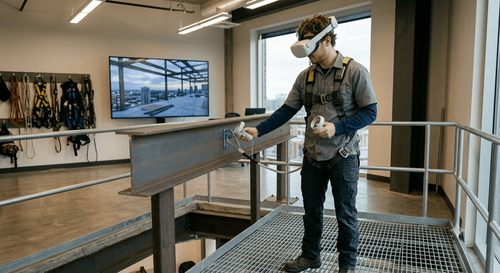
Immersive VR produces a measurable physiological response to virtual height. Learners in a well-built simulation show elevated heart rate, hesitation at edges, and altered movement patterns. Their body responds as though the exposure is real, even though the cognitive part of the brain knows it is not.
For safety training this is not a novelty. It is the entire mechanism. It means a worker can practise the decision sequence under conditions that resemble the ones where the decision actually matters.
A properly designed height module puts the learner on the structure they work on. A cement plant preheater tower. A refinery pipe rack. A transmission line gantry. A shipyard scaffold. From there the training covers:
- Pre-access checks. Inspecting the harness, lanyard and connectors for wear, deformation and expiry before ascending. Damaged equipment is deliberately seeded into the simulation so that learners have something to find.
- Anchor point selection. Learners must choose an anchor and are shown, immediately, the consequence of a poor choice through simulated load and fall physics.
- Fall clearance calculation. The single most misunderstood concept in the discipline. In VR, the learner sees exactly how much distance a shock absorber consumes, and how a short deck below turns a compliant setup into a ground impact.
- Access method selection. Scaffold, MEWP, rope access or ladder, chosen against the actual job conditions rather than an exam question.
- Rescue. What happens in the first fifteen minutes after an arrested fall, when suspension trauma becomes the real threat.
The rescue gap nobody trains for
Ask an EHS manager how many workers on site could execute a rescue-at-height within fifteen minutes of a fall. In most organisations the honest answer is a very small number, usually concentrated in one shift.
Rescue is the least practised element of work-at-height competency because practising it is genuinely difficult. It requires a structure, a suspended casualty, a rescue kit, an authorised trainer and several hours of production time. Most sites run it once a year for a small team and treat that as coverage.
In VR, rescue can be practised by every worker who works at height, in twenty minutes, as many times as needed. The learner responds to a colleague hanging in a harness, works through the decision sequence, and experiences the time pressure that makes suspension trauma dangerous. That is a fundamentally different level of preparedness from a written procedure in a file.
Building the module: what makes it work
Not every VR height module produces behaviour change. The ones that do share a few characteristics.
It uses your structures. Generic scaffolding in a generic warehouse teaches generic lessons. When the simulation recreates the actual gantry, the actual anchor points, and the actual clearance constraints of your site, the transfer to real work is immediate.
It allows failure. The most valuable moment in a height simulation is the one where the learner falls. Not as punishment, but as feedback. A worker who has experienced the consequence of a bad anchor decision in VR carries that memory onto the structure.
It scores decisions, not clicks. The system should record which anchor was chosen, whether clearance was calculated, how long the pre-use inspection took, and whether damaged equipment was identified. That is competency data. Attendance is not.
It runs in both learn and practise modes. Guided walkthrough first, with prompts and explanation. Then an unguided assessment run where the learner is on their own and the system evaluates performance.
What EHS teams get out of it
The operational case for VR height training rests on three things.
The first is coverage. A single VR station can certify a full shift in a day without booking a rig, stopping work, or waiting for weather. Contractor workforces, which are usually the highest-risk population and the hardest to train consistently, can be inducted on arrival.
The second is consistency. Every worker across every site receives an identical scenario with identical assessment criteria. For organisations running multiple plants, this removes the site-to-site variation that makes group-level safety performance impossible to compare.
The third is evidence. When a regulator, client or insurer asks how work-at-height competency is verified, a scored decision record from a simulated exposure is a substantially stronger answer than a signed attendance sheet.
Where this fits with your existing programme
VR does not replace the permit-to-work system, the physical equipment inspection regime, or the practical assessment on real equipment. It replaces the part of the programme that was never working: the classroom hours spent teaching decision-making through slides.
A typical structure looks like this. Classroom or e-learning covers the regulatory framework and equipment standards. VR covers hazard recognition, decision-making under exposure, and rescue. A short practical on real equipment confirms physical handling competence. The permit system governs the live job.
That sequence takes less total time than most existing programmes, and produces workers who have already made the critical decisions dozens of times before they make them for real.
Frequently asked questions
How long does a VR work-at-height module take per worker?
A well-scoped module runs twenty to thirty minutes for a guided pass and ten to fifteen for an assessment run. Most sites budget forty-five minutes per worker including headset fitting and briefing.
Do workers experience motion sickness at height in VR?
Modern standalone headsets with proper locomotion design keep discomfort rates low. Height modules are usually built around teleport or physical movement rather than smooth locomotion, which reduces it further.
Can it cover contractor workforces?
Yes, and this is often where the strongest return sits. Contractor induction is usually the weakest link in work-at-height governance, and VR makes a consistent, scored induction practical at scale.
Does VR training satisfy statutory training requirements?
VR supplements rather than replaces statutory requirements, which vary by sector and jurisdiction. It typically strengthens the competency evidence base that inspectors and clients ask for.
Work at height is one of the few areas where the consequence of a single poor decision is immediate and irreversible. It deserves training that puts the worker in the position where that decision is actually made.
If you want to see what a height module built around your structures would look like, EDIIIE can walk you through a working scenario."