Book a Demo
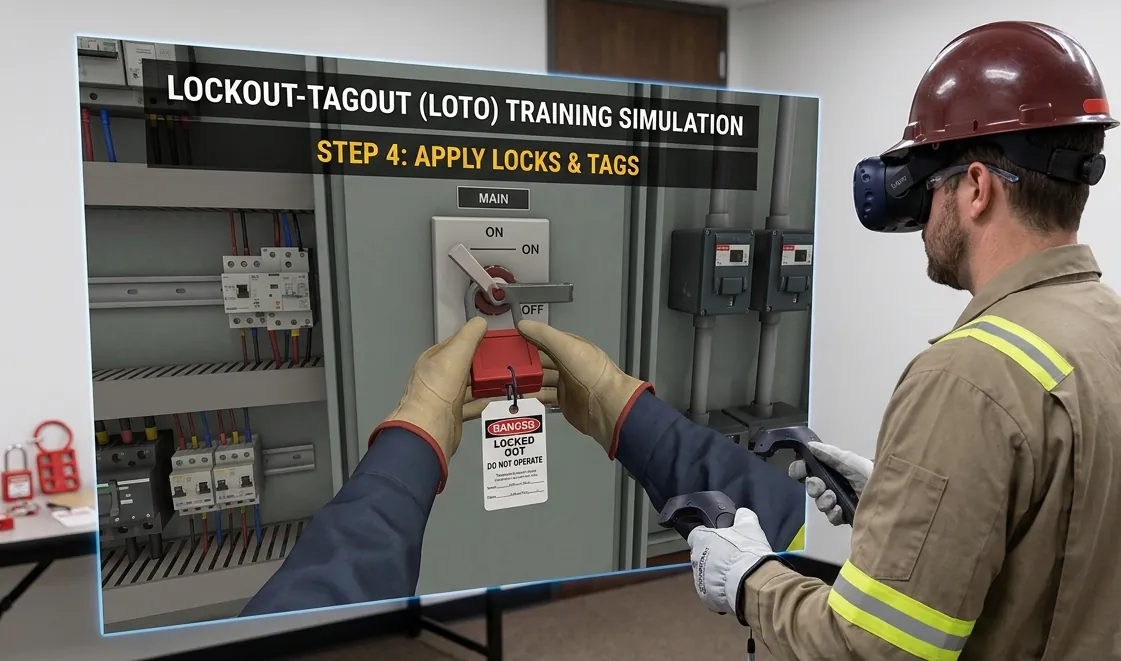
Worker in a VR headset applying a lock and tag to a main isolator in the LOTO simulation
HomeSafety TrainingLockout / Tagout
Energy Isolation & Control

Lockout / Tagout (LOTO) VR Training
Aligned to OSHA 29 CFR 1910.147

VR safety training with scored competency assessment and a dated digital certificate, deployable on standalone headsets across every site, in Hindi and English.
1910.147
OSHA standard trained
  • OSHA 29 CFR 1910.147The Control of Hazardous Energy (Lockout/Tagout), energy-control programme, procedures, training and periodic inspection.
  • IS / IE RulesIndian electrical isolation and permit-to-work practice for electrical energy sources.
  • ISO 45001Occupational health & safety management system, documented safe systems of work.
What does the OSHA lockout/tagout standard require?

The OSHA lockout/tagout standard, 29 CFR 1910.147, requires employers to establish an energy-control programme so that machines are isolated and rendered inoperative before servicing or maintenance, preventing unexpected start-up or the release of stored energy. It mandates written energy-control procedures, employee training by role (authorized, affected and other employees), and periodic inspection of those procedures at least annually. “Authorized” employees, the people who apply the locks, need the deepest training. EDIIIE’s Lockout/Tagout module trains the full sequence in VR: identify every energy source (electrical, mechanical, hydraulic, pneumatic, thermal and gravitational), shut down, isolate, apply the lockout device and personal tag, verify zero energy, and reverse the sequence to re-energise safely. Group lockout and shift-handover scenarios are included. Each attempt is scored against 1910.147 and issues an authorized-employee certificate with a dated record.

What the module covers

Built to the standard, scored on the behaviour

This module is designed around OSHA 29 CFR 1910.147 and delivered as an immersive VR simulation with three progressive modes, Learn, Practice and Assessment, with progression gated on competency. Every trainee finishes with a scored result and a dated digital certificate recorded in the LMS.

Inside the module

What the trainee sees

Screens from the Lockout / Tagout module. Every scenario is rebuilt from real plant conditions so the hazard, the equipment and the procedure match what the worker meets on shift.

Worker in a VR headset applying a lock and tag to a main isolator in the LOTO simulation
Step 4, apply locks and tags
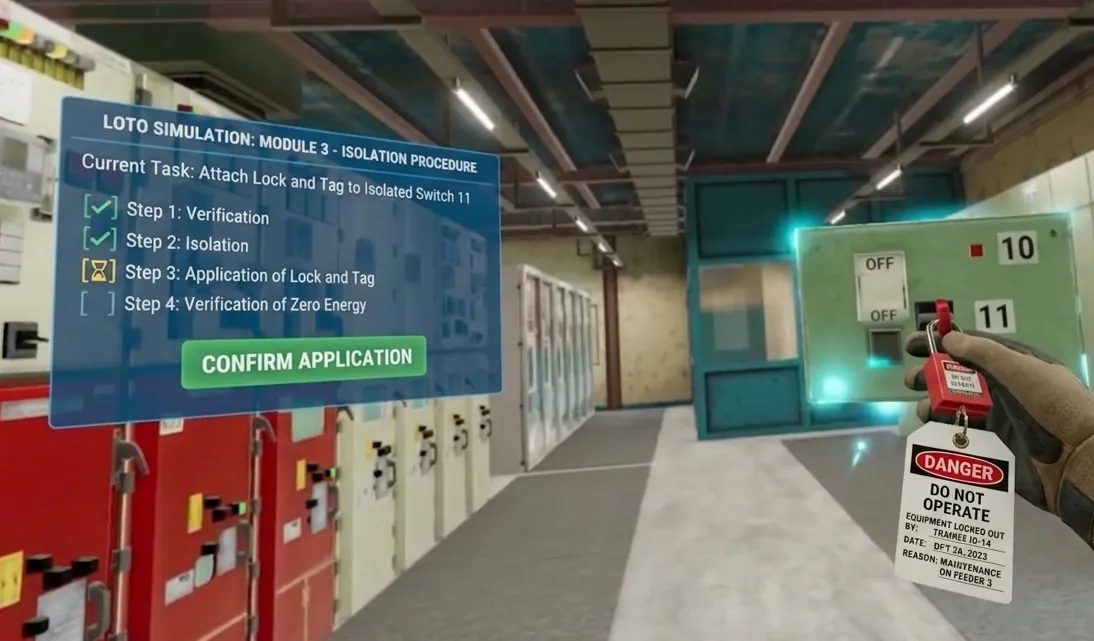
VR LOTO module showing the isolation procedure checklist beside a switchgear room
Isolation procedure checklist

Why LOTO is the clearest case for VR training

Lockout/tagout is a sequence, not a fact. Workers do not fail LOTO because they do not know it exists, they fail because a step is skipped under time pressure, a secondary energy source is missed, or the verification test is treated as a formality. Those are exactly the failures a scored VR simulation catches. In VR the trainee walks a real machine, must find every isolation point (including the hydraulic accumulator that still holds pressure after shutdown), and cannot proceed until zero energy is verified. Skip a step and the simulation shows the consequence safely. Because the assessment records which step failed, a plant can see whether its workforce’s weakness is stored-energy release or group-lock discipline, and target refresher training accordingly.

Authorized-employee certification at scale

Most sites have far more affected employees than authorized ones, and the two groups need different depth. EDIIIE’s module runs both from one deployment: a short awareness path for affected and other employees, and the full apply-the-lock path with scored assessment for authorized employees. The digital certificate distinguishes the two, so an auditor can see at a glance who is certified to apply locks. At SAIL Bhilai, electrical lockout was one of the six modules rolled out to more than 5,000 workers across shifts, the kind of scale that manual, trainer-led LOTO certification cannot reach without pulling production staff off the floor for weeks.

Compliance mapping

The standards this module maps to

Naming the standard is what separates a vendor page from a blog post, for a buyer and for an answer engine alike. Each element of the module is mapped to the requirement it satisfies.

StandardWhat it requires
OSHA 29 CFR 1910.147The Control of Hazardous Energy (Lockout/Tagout), energy-control programme, procedures, training and periodic inspection.
IS / IE RulesIndian electrical isolation and permit-to-work practice for electrical energy sources.
ISO 45001Occupational health & safety management system, documented safe systems of work.
How it is delivered

Learn, Practise, Prove

One module, three gated modes, the trainee cannot reach assessment until they have demonstrated the procedure in practice.

Learn

A guided walkthrough of the procedure and the standard behind it, at the trainee's own pace, with the hazard shown safely at full realism.

Practise

The trainee performs the procedure themselves in an interactive scenario, repeating until the sequence is correct. Wrong choices show their consequence safely.

Assess & Certify

A scored assessment against the standard. On a pass, the LMS issues a dated digital certificate and logs completion, competency score and error-per-step for audit.

Proof

Deployed on real industrial sites

Client deployment
5,000+ workers trained across 6 safety modules

At SAIL Bhilai, one of India’s largest integrated steel plants, EDIIIE deployed a six-module VR safety programme to more than 5,000 workers, covering blast furnace, coke oven, rolling mill, fire response, electrical lockout and PPE. The programme standardised safety induction across shifts and sites without taking a single worker into a live hazard area to train.

Client: SAIL Bhilai Steel Plant
Read the case study
Worker in a VR headset applying a lock and tag to a main isolator in the LOTO simulation
In-headset view, Step 4, apply locks and tags
Rollout

Runs on standalone headsets, no PC, no lab

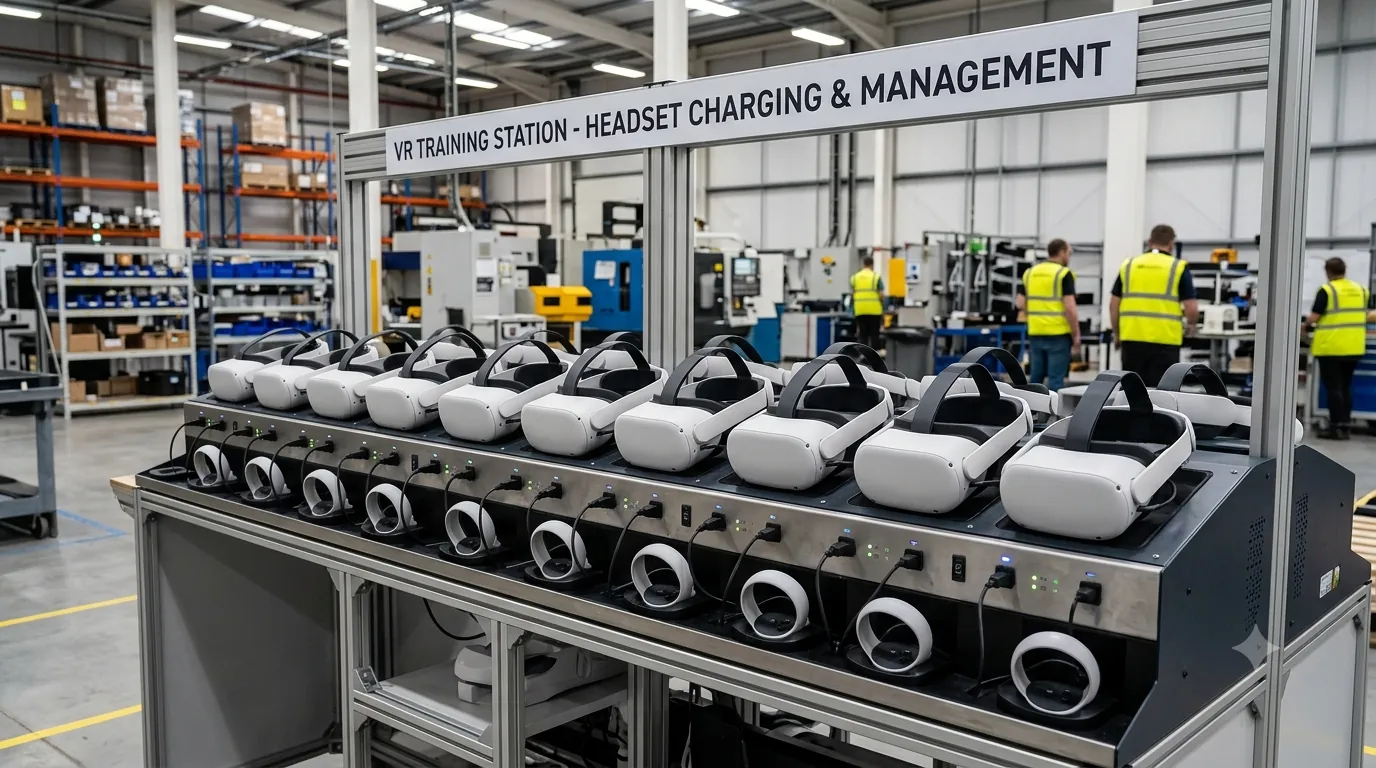
The same module ships to every site on a fleet of Meta Quest headsets with a charging station and a companion tablet for the instructor.

A VR training station with a rack of Meta Quest headsets charging on a factory floor
On-site fleet

Charge, hand out, train, in the induction room itself

A rack of headsets lives at the plant. Trainees pick one up, complete the module and hand it back; scores sync to the LMS when the headset reaches Wi-Fi. No dedicated PC per seat and no simulator room to build.

  • Standalone Meta Quest headsets, offline-capable
  • Instructor tablet mirrors the trainee's view live
  • Narration in Hindi, English and regional languages
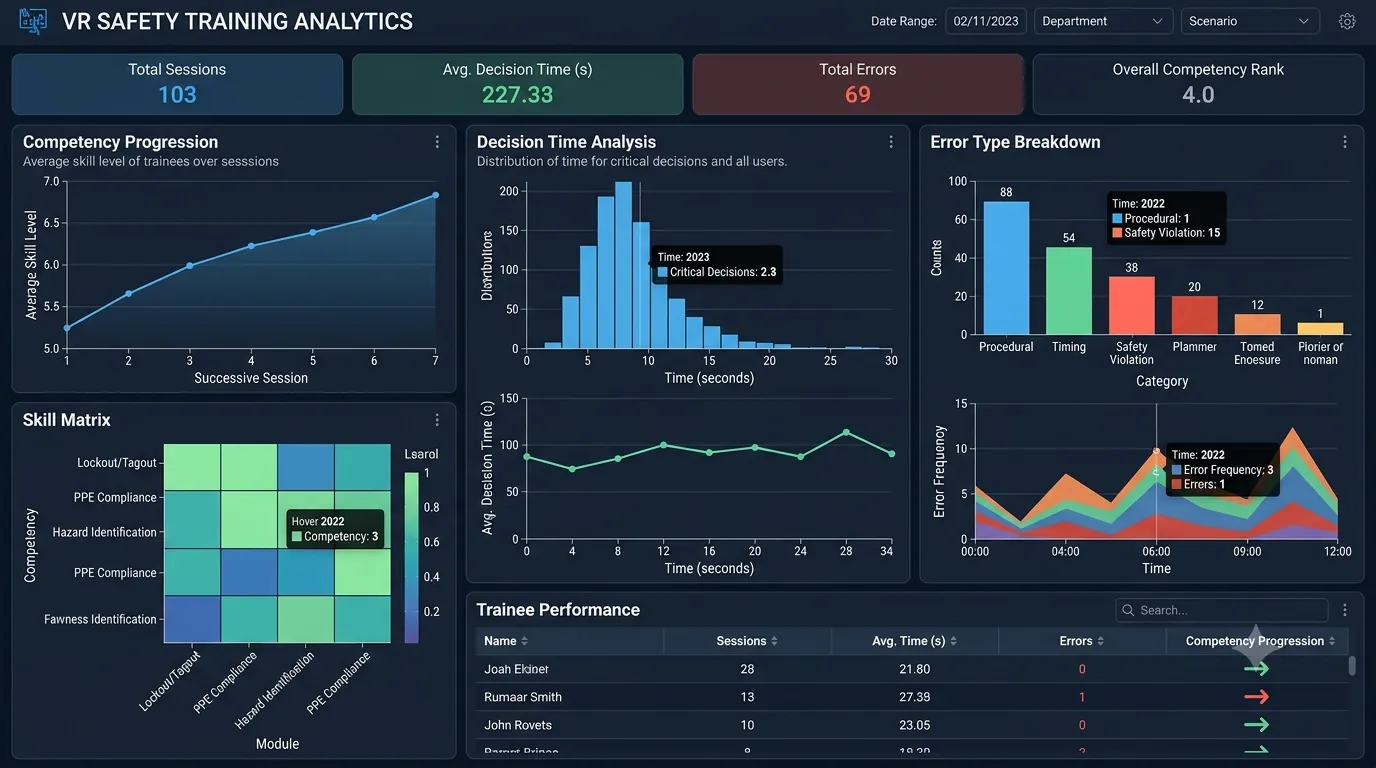
VR safety training analytics dashboard showing competency progression, decision time and error breakdown per trainee
Assessment

Every step scored, every error logged

Assessment mode records decision time, procedural errors and safety violations per step. The safety officer sees competency progression per trainee and per department, and the LMS issues a dated digital certificate on a pass.

  • Competency score, errors-per-step and time-on-task per trainee
  • Exports to your existing LMS via SCORM/xAPI or CSV
Meta Quest 3 standalone VR headset with controllers
Meta Quest 3, the standard headset for EDIIIE safety modules

Every module is built and tested for standalone Quest hardware. Headsets and the charging station can be supplied with the programme, or the module is deployed onto a fleet you already own.

Where it is deployed

Sectors that run the Lockout / Tagout module

This module is deployed across EDIIIE's industry programmes. Explore how it fits each sector:

Related modules

Often deployed together

See all 11 safety modules

FAQ

Lockout / Tagout training, common questions

1910.147 is the OSHA standard titled “The Control of Hazardous Energy (Lockout/Tagout).” It requires a written energy-control programme, role-based employee training, and at least annual periodic inspection of energy-control procedures. It is the reference standard for LOTO in the United States and is widely adopted as best practice internationally.
An authorized employee locks out and services the equipment, they physically apply the locks and tags. An affected employee operates equipment that gets locked out but does not perform the servicing. Both must be trained, but authorized employees need the full procedural competency. EDIIIE’s module runs both paths and certifies them separately.
OSHA requires retraining whenever there is a change in job assignment, machinery or procedures, whenever a periodic inspection reveals a deviation, and whenever the employer believes an employee’s knowledge is inadequate. The annual periodic inspection is a good trigger for a VR refresher, which the LMS schedules and records automatically.
Yes. The module includes group lockout using a lockbox and multi-lock hasp, plus shift-handover scenarios where a lock must be transferred, and the strict exception procedure for removing a lock when its owner is not on site. These are the situations where real LOTO incidents most often occur.
The sequence trained in the module is: notify affected employees, shut down the equipment, isolate every energy source, apply locks and tags, release or restrain stored energy, verify zero energy by attempting a start, perform the work, then remove locks and re-energise in the reverse order with affected employees notified again.
OSHA does not set a fixed expiry, but it requires retraining whenever a job assignment, machine, process or procedure changes, or when a periodic inspection, required at least annually, finds deviations. Most plants therefore refresh LOTO training annually and re-issue the certificate from the VR assessment record.

Certify your workforce on Lockout / Tagout, without the live-environment risk

Book a demo and see the Lockout / Tagout module running on a headset, scored against OSHA 29 CFR 1910.147.

Request this module