Why Indian Manufacturers Are Moving from Classroom Safety Training to VR Simulation
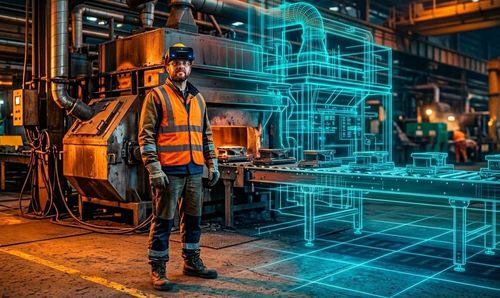
And what the early adopters are learning about cost, retention, and workforce readiness.
A steel plant in Odisha runs its annual safety induction. Forty workers sit in a room watching a PowerPoint about molten metal hazards. The room is warm. Half of them are on their phones. Two weeks later, a near-miss happens on the shop floor. The worker involved had passed the post-training assessment with flying colours.
This is not an unusual story. It is, in fact, the norm across Indian manufacturing.
Safety training in most Indian factories still runs on the same model it did twenty years ago. Classroom sessions. Printed SOPs. A video, maybe. Then a quiz. Workers pass, get certified, and go back to the floor. The compliance box is ticked. But the actual learning? That is a different question entirely.
Something is starting to shift, though. Over the last three to four years, a growing number of Indian manufacturers have started replacing parts of their classroom training with VR-based safety simulation. Not as a novelty. Not as a one-off pilot. As a core part of how they train their frontline workforce.
And the results they are seeing are hard to ignore.
The problem with classroom safety training is not the content
Let's be clear. The issue is not that manufacturers don't care about safety. Most large Indian plants have well-documented safety protocols, detailed SOPs, and dedicated EHS teams. The training content is usually thorough.
The problem is delivery.
Classroom training is passive. Workers listen to an instructor, watch a video, maybe look at some photographs of past incidents. They absorb facts. But they don't build muscle memory. They don't practise making decisions under pressure. They never feel the urgency of a gas leak alarm or the disorientation of a confined space emergency. Not until it happens for real.
This is where the gap opens up. Research consistently shows that people retain roughly 10 to 20 percent of what they read or hear in a lecture. That number jumps to 75 percent or higher when they learn by doing. VR training is, at its core, learning by doing. Except nobody gets hurt.
What VR safety training actually looks like on a factory floor
If you haven't seen industrial VR training in action, it is worth understanding what it involves. This is not gaming. It is not entertainment.
A worker puts on a VR headset and finds themselves standing inside a photorealistic replica of their actual plant. The smelter they work next to. The conveyor belt they operate. The electrical panel they maintain. Every valve, every gauge, every warning sign is where it should be.
Then the scenario begins. A chemical spill. A fire in the transformer yard. An equipment malfunction during a shift change. The worker has to respond. Follow the right SOP. Use the correct PPE. Evacuate in the right sequence. If they make a mistake, the simulation shows them exactly what would happen. No injury. No damage. Just a clear, immediate lesson.
This is why the retention numbers are so different. The experience is visceral. Workers remember what they felt, not just what they were told.
What the early data from Indian deployments shows
Several large Indian manufacturers have now completed significant VR safety training rollouts. The patterns in their data are consistent.
Training time drops. What used to take two full days of classroom instruction can be compressed into a few hours of VR simulation. Workers reach competency faster because they are practising, not just listening.
Near-miss and incident rates fall. Plants that have deployed VR safety training report reductions in safety incidents ranging from 40 to 60 percent within the first year. Some of this is attributable to better hazard recognition. Some of it comes from the confidence that repeated practice builds.
Standardisation improves across sites. One of the biggest headaches for multi-plant operations in India is maintaining consistent training quality across locations. The instructor in Jamshedpur might be excellent. The one in Vizag might be mediocre. VR eliminates this variable entirely. Every worker, at every site, trains on the same simulation, with the same standards.
Assessment becomes objective. In a classroom, a worker can pass a written test without truly understanding a procedure. In VR, you can see exactly how they respond. Did they check for gas before entering the confined space? Did they follow the lockout-tagout sequence correctly? The data is granular, timestamped, and impossible to fake.
The cost question that every procurement team asks
Let's address this directly, because it is usually the first objection.
VR training requires upfront investment. Headsets, custom simulation development, deployment infrastructure. A single VR training module for a specific industrial process can range from a few lakhs to low crores, depending on complexity and the level of fidelity required.
But the comparison needs to be fair.
Classroom training has costs too. They are just hidden. Instructor salaries. Travel for multi-site deployments. Production downtime when workers are pulled off the floor for two-day sessions. The cost of the training facility itself. And most importantly, the cost of the incidents that still happen because the training didn't stick.
When manufacturers run the numbers honestly, most find that VR training reaches cost parity with classroom methods once they have trained somewhere between 200 and 400 workers on a given module. After that, the marginal cost per trainee drops sharply because the simulation is reusable. The instructor does not need to fly to the next plant. The content does not degrade.
Companies like Intel have publicly reported a 300 percent ROI on their VR safety programmes over five years. PwC's research found that VR training becomes 52 percent cheaper than classroom delivery at scale. These numbers are from global deployments, but the economics hold even more favourably in India, where travel and logistics costs for multi-site training are particularly high.
Beyond safety: where this is heading
Most Indian manufacturers start with safety training because the business case is clearest there. The cost of a single serious workplace injury, in human terms and in rupees, makes the investment obvious.
But once the infrastructure is in place, the applications multiply.
Equipment operation training. Instead of tying up a real CNC machine or a real turbine for training, workers learn on a virtual replica. The production line keeps running. Maintenance procedure training. Technicians practise complex repair sequences in VR before touching live equipment. Onboarding. New hires at a cement plant or a steel mill can walk through the entire facility in VR on their first day, before they ever step onto the actual shop floor. Pre-commissioning walkthroughs. Before a new plant or a new production line goes live, the operations team can rehearse procedures in a digital twin of the facility.
This is where technologies converge. VR training, augmented reality for on-the-job guidance, and digital twins for operational planning are not separate investments. They are layers of the same capability. Manufacturers who start with VR safety training are building the foundation for a much broader digital transformation of their workforce operations.
What to look for if you are evaluating VR training for your plant
Not all VR training is created equal. The market in India is growing, and not every provider has the depth to deliver industrial-grade simulation. Here is what matters.
Process accuracy comes first. A VR simulation that looks impressive but doesn't faithfully replicate your actual equipment, your actual SOPs, and your actual plant layout is a toy. It might generate a few "wow" moments during a demo, but it will not change training outcomes. The simulation needs to be validated by your own process engineers and safety teams before deployment.
Scalability is non-negotiable. If you are a single-site operation, almost any solution will work. But if you have five plants, or fifteen, or fifty, you need a deployment architecture that scales. Cloud-based content delivery, centralised analytics, and the ability to update scenarios without re-developing from scratch.
Analytics integration matters more than you think. The real value of VR training shows up in the data. Competency scores, error patterns, time-to-mastery, repeat-training triggers. This data should feed into your existing LMS and your EHS reporting systems. If the VR provider cannot integrate with your enterprise systems, you will end up with a standalone tool that nobody maintains after the first quarter.
Domain expertise is the differentiator. Building VR for gaming is one skillset. Building VR for industrial safety training is a completely different discipline. You need a partner who understands your industry, your regulatory environment, and the specific hazards your workers face. A provider who has built simulations for smelter operations, or for oil rig safety, or for high-voltage maintenance, will deliver a fundamentally different product than a general-purpose VR studio.
The bottom line
Classroom safety training served Indian manufacturing well for decades. It was the best option available. It is no longer the best option available.
VR simulation does not replace every aspect of training. Workers still need mentoring, hands-on practice with some equipment, and classroom time for regulatory and theoretical knowledge. But for the high-stakes, high-risk scenarios where the consequences of getting it wrong are severe, and where repetition and muscle memory matter most, VR is proving to be decisively better.
The manufacturers who are adopting it now are not doing so because it is trendy. They are doing it because their near-miss data, their injury rates, and their training completion metrics are telling them the same thing: what they were doing before was not working well enough.
The technology is mature. The economics work at scale. The evidence is clear.
The question is no longer whether VR safety training works. The question is how quickly you can deploy it across your workforce before your competitors do.
EDIIIE has been building enterprise-grade VR, AR, and Digital Twin simulation solutions for industrial training for over a decade. With 170+ projects delivered and 800+ VR experiences built for organisations including ISRO, DRDO, Hindalco, Tata Projects, and DMRC, we design process-accurate simulations that are validated by your teams and deployed at scale. Talk to us about your training challenge.