GMP and Cleanroom Behaviour Training in VR: Where Pharma Training Usually Falls Short

"A cleanroom is only as clean as the behaviour of the last person who walked through it.
Pharmaceutical manufacturing has one of the most rigorous training regimes in industry. GMP training is mandated, documented, periodically refreshed and inspected. Every operator has a training file that can be produced on demand.
And yet contamination events, deviations and data integrity findings persist, and when the root cause analysis is done, it very often lands on human behaviour inside the classified area. A slow movement that became a fast one. A glove that touched a surface it should not have. A gowning sequence performed correctly ninety-nine times and imperfectly on the hundredth.
The reason is structural. Cleanroom behaviour is a physical skill performed under constraint, and it is taught almost entirely through documents and classroom sessions, because practising inside a classified area is expensive and practising outside one is unrealistic.
Key takeaways
- GMP training is document-heavy while the actual risk sits in physical behaviour inside classified areas.
- Practising in a real cleanroom consumes gowning materials, classified area time and batch schedule.
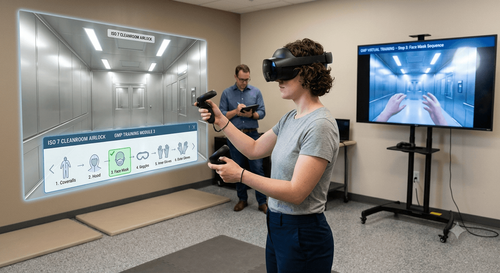
- VR lets operators rehearse gowning, aseptic technique and intervention handling without entering the area.
- Contamination can be made visible in simulation, which no physical training can do.
- Recorded, scored sessions strengthen the training documentation that inspectors examine.
The cost of practising in a real cleanroom
Every hour of training inside a classified area carries a real cost. Gowning consumables for each entry. Environmental monitoring implications. Cleaning and requalification if something goes wrong. And most significantly, occupancy of a room that is scheduled for production.
The result is that hands-on cleanroom training gets minimised. Operators receive gowning qualification, which is a formal assessment, and then learn the rest of their behavioural discipline through observation and on-job correction.
That works reasonably well for the routine. It works poorly for the exceptional, which is exactly where contamination events originate. A line stoppage requiring intervention. An unexpected spill. Equipment behaving abnormally. A visitor who does not know the rules. Each of these is a moment where trained behaviour degrades under pressure, and none of them can be scheduled for practice.
Making contamination visible
The most useful thing VR does in a pharmaceutical context is not the gowning practice, useful as that is. It is visualisation.
Contamination is invisible. Particle shedding is invisible. Airflow is invisible. First air is a concept operators are taught to protect without ever seeing it. Unidirectional flow disruption from a hand passing over an open vial is described in words and diagrams.
In simulation, all of this can be rendered. Learners see particles shed from their own movement. They see the airflow pattern in a Grade A zone and watch it break when they reach across. They see the contamination trail left when a gloved hand touches a non-sterile surface and then a product contact surface.
Operators who have seen their own movement disturb first air behave differently at the line. That is not a training claim, it is a consistent observation from organisations that have implemented it.
What the modules typically cover
Gowning and degowning. The full sequence for each grade, in the actual airlock layout of the facility, with the specific garments used. Sequence errors, surface contact and skipped steps are flagged in real time in learn mode and recorded silently in assessment mode. Degowning is included, because it is the more commonly rushed and more commonly incorrect procedure.
Material and personnel flow. Pass-through use, airlock discipline, understanding pressure cascades and why a door held open matters, and the movement patterns that maintain segregation between clean and less clean areas.
Aseptic technique. Slow deliberate movement, hand positioning relative to open product, tool handling, and the interventions that are permitted versus those that require line clearance.
Interventions and deviations. A stopper jam, a fallen vial, a broken container, an alarm on the isolator. Each requires a decision about whether to intervene, how, and what documentation follows.
Line clearance and changeover. The systematic verification that no material from the previous batch remains, which is procedurally simple and one of the most common sources of findings.
Data integrity and documentation. Contemporaneous recording, correction procedures, and the pressure situations where shortcuts appear. A simulation can present the situation where a record was not made at the time and the operator has to decide what to do about it.
Equipment training without a batch
Beyond behaviour, VR is effective for equipment familiarisation on the specific machines in the facility. Filling lines, lyophilisers, isolators, autoclaves, capping machines and inspection systems.
Operators can be taken through setup, changeover, routine operation, fault conditions and cleaning procedures on a digital replica, before they touch a machine that is either in production or under qualification. For new facilities and new lines, this compresses the ramp-up period substantially, because operators arrive at commissioning already familiar with the sequence.
Maintenance technicians benefit similarly. Complex maintenance procedures on production equipment can be rehearsed rather than learned during a scheduled shutdown with a supervisor watching the clock.
Training documentation that stands up
Inspectors examine training records. What they generally find is attendance, an assessment score, and a signature.
A simulation platform produces something more substantial: a record of what the operator actually did. Gowning sequence completed correctly on which attempt. Contact events recorded. Time taken. Aseptic technique score. Intervention handled correctly or not.
For a quality organisation this changes the nature of training effectiveness evidence, which is a recurring area of regulatory attention. It also makes retraining decisions defensible, because the specific deficiency is documented rather than inferred.
The same data supports gowning qualification programmes, giving a quantitative element alongside the microbiological result.
Where it fits with existing qualification
VR does not replace gowning qualification, which requires microbiological assessment. It does not replace on-job training or the qualification of aseptic operators through media fill participation.
What it replaces is the preparation for those things. Instead of an operator's first serious gowning practice being their qualification attempt, they arrive having performed the sequence twenty times. Instead of learning intervention handling during a real intervention, they have handled a dozen in simulation.
Organisations that have implemented this report shorter time to qualification, fewer qualification failures, and a reduction in behaviour-related deviations. The last is the one that matters commercially, because each deviation carries investigation cost and, in the worst cases, batch cost.
Frequently asked questions
Does VR replace gowning qualification?
No. Microbiological gowning qualification remains a requirement. VR is preparation and ongoing practice, which typically improves first-attempt qualification rates.
Can it model our specific facility?
Yes. Airlocks, cleanroom layouts, equipment and garment types are built to match the actual site, which is what makes the training transfer.
Is this accepted by regulators?
VR is used as a training and preparation tool within existing GMP training frameworks. It does not change the qualification requirements, and it strengthens the training effectiveness evidence that inspections examine.
What about biotech, medical devices and food manufacturing?
The same approach applies to any environment with controlled contamination requirements, including biologics, sterile devices and high-care food production.
If you want to see your own gowning sequence and cleanroom layout as a training simulation, EDIIIE can build it from your SOPs and facility drawings."