Process Safety Training for Chemical Plants: Building Judgement Before the Upset

"Process safety incidents are almost never caused by someone who did not know the procedure. They are caused by people who ran out of time to think.
A chemical process upset develops on its own schedule. Pressure rises, a temperature trends the wrong way, a reading contradicts another reading, and the operator has a window measured in minutes to diagnose and act. In that window they are working with incomplete information, competing alarms, and a plant that is still running.
Nothing in conventional training prepares anyone for this. Process safety management training covers hazard analysis, management of change, and the elements of the standard. Operator training covers normal operations and the written procedures for abnormal conditions. Emergency drills cover evacuation and, occasionally, a tabletop exercise.
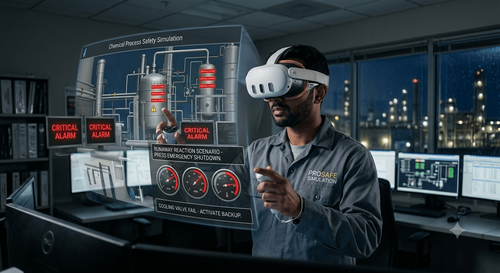
What is missing is repetition of the actual cognitive task: recognising an abnormal situation early, diagnosing it correctly, and executing the right response under time pressure. VR and immersive simulation can deliver that repetition.
Key takeaways
- Most process safety failures are diagnosis and response failures, not procedural ignorance.
- Abnormal situation management requires practice, and the plant cannot be used for practice.
- VR combines field and control room perspectives, which conventional simulators usually separate.
- Scenario libraries let organisations train against their own incident and near-miss history.
- The same environment supports operator competency, contractor induction and emergency response coordination.
The abnormal situation problem
Operators spend most of their careers in normal operations. A well-run plant produces very few genuine upsets, which is the objective, and also the training problem. Experience with abnormal conditions accumulates slowly, unevenly, and often only in the memory of a handful of senior operators approaching retirement.
When an upset does occur, the operator's response depends on pattern recognition. Have I seen this before. Does this combination of readings mean what I think it means. Is this instrument lying to me.
An operator with twenty years of upsets behind them diagnoses quickly. An operator with two years does not, and no amount of procedure reading closes that gap, because procedures are indexed by problem and the operator's difficulty is identifying which problem they have.
Simulation is how other high-consequence industries solved this. Aviation does not wait for pilots to accumulate engine failures. It gives them dozens in a simulator. Process industries have had DCS training simulators for years, but access is limited, they are typically control-room only, and they train the panel operator while leaving the field operator out entirely.
What immersive simulation adds to the existing simulator
The distinction worth drawing is between a process simulator and an immersive training environment. They do different things and the strongest programmes use both.
A high-fidelity process simulator models the chemistry and the control system. It answers what happens to the plant.
An immersive VR environment models the physical plant and the human response. It answers what the operator does, where they go, what they see, who they talk to, and how long it takes.
Real incidents live in the second category. The field operator who has to reach a manual valve. The communication between the panel and the field. The decision to initiate emergency shutdown, which is technically simple and organisationally difficult, because shutting down a plant has costs and operators hesitate.
Connecting the two, so that actions in the immersive environment drive a real process model, produces training that covers the full loop.
Scenarios worth building
The scenario library is where the value sits, and the best source material is your own history.
Runaway reaction. Temperature excursion in a batch reactor, cooling underperforming, and a narrowing window before relief. The learner must diagnose cause, attempt correction, and decide when to abandon correction and go to emergency measures.
Loss of containment. A flange leak on a hydrocarbon or toxic service line. Field operator response, isolation, area evacuation, gas detection interpretation, ignition source control.
Utility failure. Loss of instrument air, cooling water or power. These cascade in ways that are hard to reason about from a procedure, and they underlie a substantial share of real incidents.
Instrument disagreement. Two readings that cannot both be true. Which one is believed determines whether the response is correct or catastrophic.
Startup and shutdown. Statistically the most hazardous phases of operation, performed least often, with the most transient conditions.
Permit-to-work and hot work. Contractor entering a live unit, gas testing, isolation verification, and the field conditions that invalidate a permit issued an hour earlier.
Each scenario should be seeded with the genuine ambiguity of a real event. An upset where every reading points cleanly at one cause teaches nothing.
Training the whole response, not just the operator
A process safety event pulls in the shift in charge, the field operators, the maintenance team, the emergency response team, and eventually plant leadership. The failure modes at that level are coordination failures: unclear command, delayed escalation, conflicting instructions, and information that does not travel.
Multi-user VR allows a full response team to work a scenario together from different locations and different roles. The panel operator sees the DCS. The field operator sees the unit. The incident commander sees the emergency management interface. They communicate over the same radio channels they use in reality.
This is a fundamentally different exercise from a tabletop. In a tabletop, someone reads a scenario aloud and participants describe what they would do. In an immersive exercise, participants have to actually do it, in real time, with the information they actually have, and the gaps show up immediately.
Making it count for competency assurance
Process safety competency is typically assessed through written tests, on-job observation and periodic revalidation. Regulators and corporate audit functions increasingly want evidence that competency is verified rather than assumed.
Simulation produces that evidence directly. For each learner and scenario, the system records time to recognise the abnormal condition, diagnosis accuracy, actions taken and their sequence, whether emergency shutdown was initiated within the safe window, and whether communication protocols were followed.
Aggregated across a plant, this data also surfaces systemic issues. If most operators misdiagnose the same scenario, that is not an operator problem. It is an alarm design problem, a procedure problem or an instrumentation problem, and the simulation found it before the plant did.
Getting started without boiling the ocean
Building a full plant model with connected process simulation is a substantial programme. Very few organisations should start there.
A more practical entry point is a single unit and three to four scenarios drawn from actual near-misses. Build it, run the operating crews through it, and compare their performance against what you expected. The findings from that first exercise usually justify the expansion and, more importantly, tell you which scenarios to build next.
From there the environment extends unit by unit, with scenarios added as incidents, near-misses and management-of-change events generate new training needs.
Frequently asked questions
Can VR connect to our existing process simulator or DCS?
Yes. Integration with an existing dynamic process model or an emulated DCS is common, so that operator actions in VR drive real process behaviour.
Does this replace our DCS operator training simulator?
No. It complements it by covering the field operator, the physical plant and team coordination, which panel-only simulators do not address.
How do we choose which scenarios to build first?
Start with your near-miss register and your process hazard analysis. The scenarios with the highest consequence and the least practice opportunity are the ones to build.
Is this viable for a mid-sized plant, or only for large operators?
Scoped to one unit and a small scenario set, it is well within reach of mid-sized operations. The cost driver is scenario count and process model fidelity, both of which can be phased.
If you want to explore what a scenario built from your own near-miss history would look like, EDIIIE can develop a working example for one unit."